Digit Span Test: Average Scores, What They Mean and the World Record
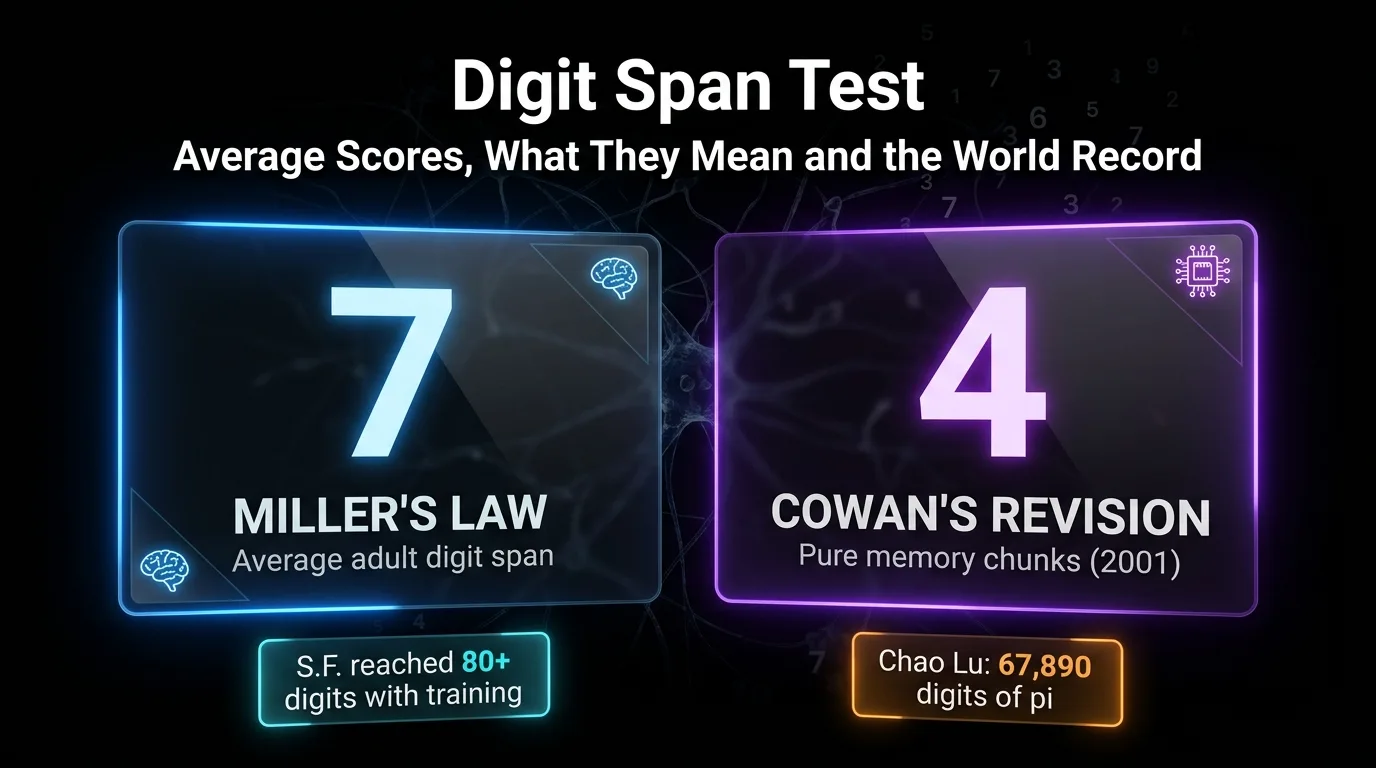
The average adult can hold 7 digits in short-term memory, a finding established by Harvard psychologist George A. Miller in his 1956 paper in Psychological Review. Nelson Cowan revised this in 2001, arguing the true capacity is closer to 4 pure chunks when rehearsal is blocked. Here are the average digit span scores by age, the WAIS-IV norms, and what the world record actually looks like.
What Is a Digit Span Test
A digit span test measures your ability to remember and repeat a sequence of numbers in the exact order they were presented. The items are always single digits from 0 to 9, which keeps the content neutral and isolates raw capacity. It is one of the oldest and most reliable measures of short-term memory and working memory in all of psychology.
There are three variants, and they are not interchangeable. Forward span asks you to repeat the sequence in the order you heard it, which measures verbal short-term memory in its simplest form. Backward span asks you to reverse the sequence, which draws on working memory and the central executive that holds and manipulates information at once. Sequencing asks you to recall the digits in ascending order, which requires you to reorder the whole string in your head before answering.
Both the WAIS-IV and the WISC-IV include all three variants as standard subtests. Clinical sequences start at just 2 items and grow one digit at a time until your errors mark the edge of your span. Take the free Number Memory Test to find your digit span right now.
Average Digit Span Scores by Age
Miller put the figure at 7 plus or minus 2, the famous range that gave his paper its title. Cowan's 2001 revision lowered the real number to about 4 pure chunks. The two are not contradictory. Miller's 7 already includes the boost you get from silently rehearsing and grouping digits, while Cowan's 4 is the biological floor you are left with once those tricks are stripped away.
Capacity is not fixed across life. It climbs through childhood, plateaus in the teens, then slips again in old age.
| Age | Average Forward Span |
|---|---|
| Age 4 | ~3 digits |
| Ages 6-8 | ~5 digits |
| Ages 9-12 | ~6 digits |
| Age 16 | 7-8 digits (plateau) |
| Adult 16-64 | ~7 digits |
| Age 65+ | Gradual decline |
Once you have your own number, here is how to read it against the adult population:
How to Interpret Your Digit Span Score
| Your Score | Level |
|---|---|
| 3-4 digits | Below average |
| 5-6 digits | Developing |
| 7-8 digits | Average adult |
| 9-10 digits | Above average |
| 11+ digits | Exceptional |
For clinical context, the WAIS-IV reports cumulative raw score averages across multiple trials rather than your single longest string. For ages 16-64 those averages are 10.5 forward, 8.8 backward, and 8.7 sequencing. For ages 65-90 they drop to 9.5 forward, 7.6 backward, and 6.9 sequencing. Because these accumulate points across every trial, do not compare them directly to the single-sequence number a browser test gives you.
The World Record and What It Actually Proves
In 2005 Chao Lu set the Guinness World Record by reciting 67,890 decimals of pi, a feat that took 24 hours and 4 minutes. He did not brute-force it. He encoded number pairs as specific images and wove them into long, vivid narrative stories that his mind could walk through in order.
A research example makes the mechanism even clearer. In the 1982 study by Chase and Ericsson, a participant known as S.F. pushed his digit span from a normal level to more than 80 digits over months of practice. When the researchers sped up the presentation rate to block his chunking strategy, his performance dropped straight back to normal. His biological capacity never moved at all. Only his strategy did.
That is the whole lesson. An exceptional digit span is a strategy skill, not a raw memory skill. Memory athletes lean on the method of loci, the Major System, and the PAO (Person-Action-Object) System to turn meaningless numbers into images they can actually hold. The ceiling people break through is strategic, not biological. The same visuospatial machinery is what the chimp test taps, so it is worth seeing how your scores on the two compare.
What Affects Your Digit Span Score
Intelligence and academic outcomes track with span more than people expect. Digit span correlates with full-scale IQ at around r=0.43 in typical children, rising to 0.6-0.8 once learning difficulties are included in the sample. Working memory in turn predicts reading comprehension, mathematical aptitude, and performance on the ACT and SAT, which is why it shows up in so many assessment batteries. It is also the scratchpad behind quick mental arithmetic, so a strong span tends to show up as a faster math speed test score too.
ADHD has a recognizable signature here, specifically a deficit in visuo-spatial working memory, so digit span scores commonly sit below average in ADHD populations. Age matters too. Span peaks in late adolescence around 16, holds for decades, then declines after 65, and working memory fades faster than the crystallized knowledge you accumulate over a lifetime. The same lifespan slope shows up in cognitive decline by age for processing speed.
Emotional state quietly moves the number as well. High negative emotionality and anxiety both interfere with working memory, so test anxiety alone can pull your measured span below your true capacity. On the WAIS-IV working memory composite, males score slightly higher on average, though the practical gap is small.
Can You Actually Improve Your Digit Span
You can improve your score through strategy, but not your underlying biological capacity. The S.F. study is the cleanest proof on record: 80+ digits with chunking, back to baseline the moment chunking was blocked. Chunking works by grouping loose digits into meaningful clusters. The sequence "1, 9, 4, 5" becomes "1945", which occupies a single memory slot instead of four. Your effective span expands while the hard limit underneath it stays exactly where it was.
This is also why commercial brain training disappoints. The 2012 review by Shipstead, Redick and Engle concluded that programs including Cogmed do not systematically produce broad cognitive change. Jaeggi et al. 2008 found that n-back training improved fluid intelligence in some studies but failed to show reliable transfer to other working memory tasks. Better scores after training mostly reflect strategy and task familiarity, not a bigger tank.
There is a real payoff for gamers, though. Working memory capacity links to attentional control and to dynamic decision-making, both of which carry directly into RTS and MOBA play. A higher working memory load capacity helps you track multiple units, manage a fistful of ability cooldowns, and hold the full game state in mind under pressure all at the same time. Your digit span is one of the inputs in the Mental Age Test, so take both to compare your working memory against your processing speed.
Frequently Asked Questions
What is the average digit span for adults?
The average adult forward digit span is approximately 7 items, as established by George A. Miller's 1956 paper in Psychological Review. Nelson Cowan revised this in 2001, arguing true biological capacity is closer to 4 pure chunks when rehearsal strategies are blocked. The average backward digit span for adults is 4-5 items.
What is a good score on a digit span test?
For adults, a forward span of 7-8 digits is average. A score of 9-10 is above average. Eleven or more is exceptional. Backward span averages 4-5 for healthy adults, always lower than forward span because reversing the sequence requires active mental manipulation rather than simple recall.
What is the world record for digit span?
Chao Lu set the Guinness World Record in 2005 by reciting 67,890 decimals of pi over 24 hours and 4 minutes. In a research context, Chase and Ericsson's 1982 study showed participant S.F. reaching 80+ digits after months of practice using chunking, though when the strategy was blocked his span returned to normal immediately.
Can you improve your digit span?
You can improve your test performance through strategy but not your underlying biological capacity. The S.F. study proved this with 80+ digits through chunking, then a drop back to normal when chunking was prevented. The most effective method is chunking: grouping digits into meaningful units so each cluster occupies one memory slot instead of several.
Want to find your digit span right now? Take the free Number Memory Test on ToolsBracker. No signup, instant result, works in any browser.
Free, no signup, results in seconds.
Take the Number Memory Test