Mental Age Test: How It Works and How Accurate It Really Is
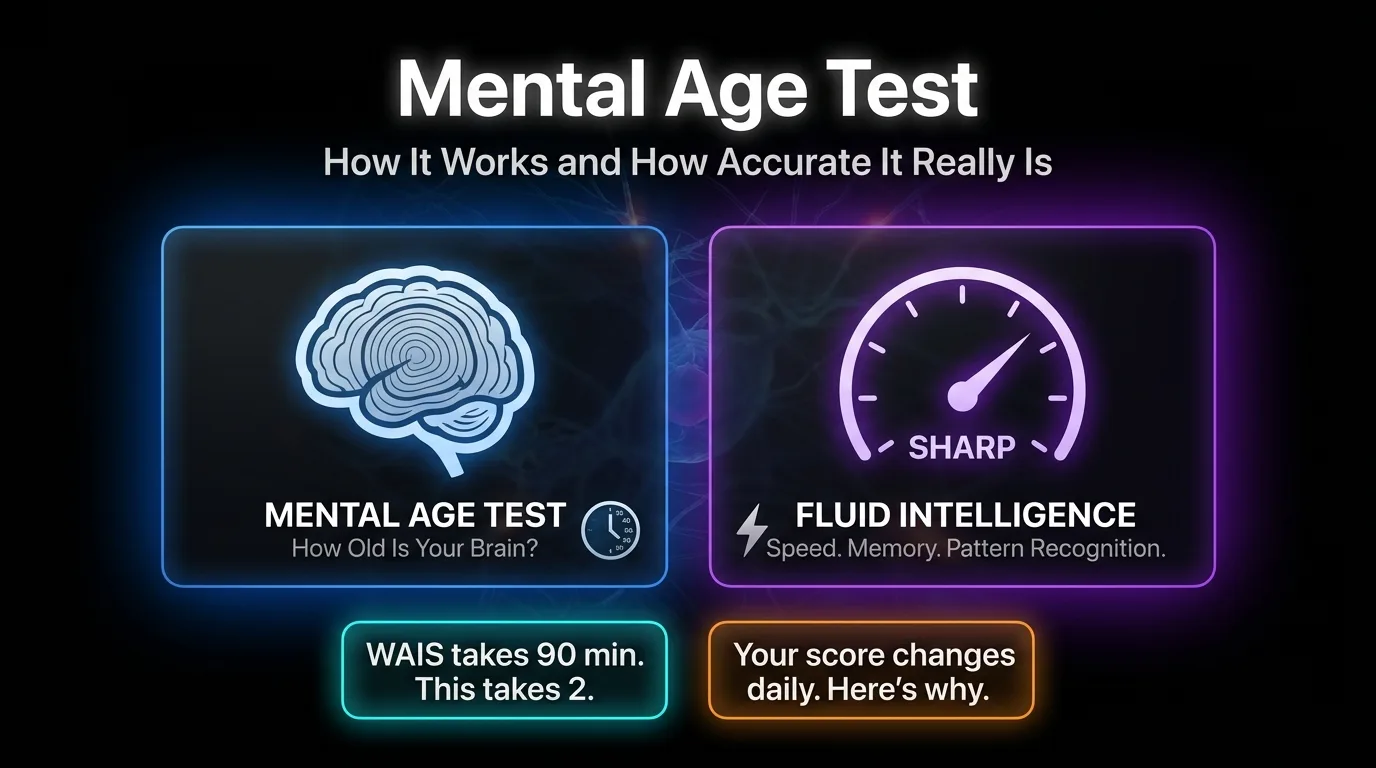
A mental age test result is not a diagnosis, it is a comparison. The test measures how fast and how accurately you handle a handful of cognitive tasks, then tells you which age group typically performs the way you just did. Respond like a sharp 19-year-old and that becomes your mental age, even if your knees strongly disagree. Here is exactly how that estimate gets built, and how much weight it can actually carry.
How a Mental Age Test Calculates Your Result
Under the hood, the test is a small battery of timed challenges. One task asks you to hold a sequence in your head, another checks how quickly you spot a pattern or react to a change on screen. Each one targets a cognitive skill that researchers have tracked across the lifespan, so each one has a known performance curve from childhood to old age.
Your speed and accuracy on every task get combined into a single composite. The test then slides that composite along the lifespan curve until it finds the age group whose typical performance looks most like yours. That match is the number you see at the end.
Notice what the test never asks: your actual age, your education, your job. The estimate is built entirely from how you performed in those two minutes. That is its charm and its limitation at the same time.
From French Classrooms to Browser Quizzes
The concept has a surprisingly serious origin story. The French education ministry asked Alfred Binet to find a way to identify schoolchildren who needed extra support, and the 1905 Binet-Simon scale solved it by expressing ability as an age level. A child who handled the puzzles most 10-year-olds could handle had a mental age of 10, whatever their birthday said.
William Stern then turned the comparison into a quotient, and Lewis Terman popularized it worldwide through the Stanford-Binet test. The famous IQ formula, mental age divided by chronological age times 100, ruled intelligence testing for decades.
It eventually collapsed for one simple reason: adult cognition refuses to climb a neat yearly ladder. There is no set of puzzles that separates a typical 38-year-old from a typical 43-year-old, so David Wechsler replaced the ratio with deviation IQ, which compares you to your own age group instead. The specific failure was mechanical: mental age scores plateau around age 15 because tests run out of harder tasks, while chronological age keeps climbing. An adult's ratio IQ would mathematically shrink every birthday regardless of actual ability. Clinical psychology moved on. The mental age idea survived as what it is today: a fun comparison, not a clinical measure.
What Your Result Actually Reflects
The kernel of truth inside the novelty is real: cognitive performance genuinely does change with age, just not in one direction. Psychologists split it into fluid intelligence, the raw speed and flexibility that favors the young, and crystallized intelligence, the accumulated knowledge that keeps growing for decades. A two-minute browser test leans heavily on the fluid side, which is why quick reflexes pull your estimate down and careful, deliberate answering pushes it up.
Raymond Cattell formalized this split in 1963, and John Horn's 1967 research proved the two move in opposite directions across a lifetime. A landmark study by Hartshorne and Germine 2015 analyzed over 48,000 online participants and found that different cognitive abilities peak at completely different ages: processing speed at 18-19, short-term memory around 25, and working memory at 30-35. A two-minute browser test samples the early-peaking skills, which is why younger results are common even in sharp, high-functioning adults. Take the Mental Age Test and see which skills your score reflects most.
Here is the practical translation of each outcome:
| If your result is... | What it usually reflects |
|---|---|
| Younger than your age | Fast, accurate responses on the speed-heavy tasks that day |
| Close to your age | Performance typical of your age group, the most common outcome |
| Older than your age | Slower or more deliberate answering, often fatigue or an unfamiliar task style |
Processing speed is the ingredient that moves the most, and it is also the easiest to measure on its own. The average reaction time by age breakdown shows the same lifespan curve this test borrows from, decade by decade. Working memory is the other big input, and you can isolate it with the number memory test or compare yourself to the famous chimpanzee study in the chimp test average score guide.
When Different Cognitive Skills Peak
| Cognitive Skill | Peak Age | Source |
|---|---|---|
| Processing speed | 18-19 | Hartshorne & Germine, 2015 |
| Short-term memory | ~25 | Hartshorne & Germine, 2015 |
| Working memory | 30-35 | Hartshorne & Germine, 2015 |
| Emotional recognition | 40-48 | Hartshorne & Germine, 2015 |
| Crystallized intelligence | Late 50s-60s | Cattell/Horn |
This is why no single number captures your full cognitive picture. You can have the processing speed of a 19-year-old and the vocabulary of a 45-year-old at the same time.
How Accurate Is a Mental Age Test?
Honest answer: it is entertainment-grade, and anyone telling you otherwise is selling something. A real cognitive assessment like the WAIS takes 60 to 90 minutes with a trained examiner and is normed on carefully sampled populations. A browser quiz samples a few tasks in two minutes on whatever device you happen to be holding. The result is a rough, genuine reflection of your speed and accuracy in that moment, nothing more.
That moment matters more than people expect. Sleep debt alone can slow cognitive processing enough to age your estimate by a decade, the same way your aim falls apart in a 2am ranked queue. Caffeine nudges the number the other way. Take the test twice and your second run usually scores younger, not because your brain improved overnight but because you knew the task format. Phone versus mouse changes input speed too.
One thing this test is not: a screening tool. If you have real concerns about memory or thinking changes, in yourself or someone close to you, that is a conversation for a doctor or neuropsychologist, not a browser game. A playful estimate has no business in that decision.
How to Get Something Real Out of a Novelty Test
Treat the number as a benchmark instead of a verdict and it becomes genuinely useful. Run the test well-rested to set a baseline. Then retest after a short night, after a workout, after your third coffee, and watch which conditions move your score. You are not measuring your intelligence, you are measuring what your habits do to your processing speed, and that feedback loop is real.
Gamers have an extra reason to care. The fluid skills this test samples, reaction speed, working memory, pattern recognition, are the exact skills that decide clutch rounds. If your mental age estimate keeps coming back old and your ranked performance feels sluggish too, those are probably the same problem wearing two costumes. Fix the sleep first and retest both.
Frequently Asked Questions
How accurate is a mental age test?
Online mental age tests are entertainment-grade estimates, not validated assessments. They genuinely measure your speed and accuracy on a few cognitive tasks, but clinical instruments like the WAIS take over an hour with a trained examiner. Treat the result as a fun snapshot of your performance that day.
Is mental age still used in psychology?
Not as a clinical measure. The mental age ratio behind the original IQ formula was retired because adult cognition does not progress in yearly steps. Modern tests use deviation IQ, which compares your performance to people your own age rather than assigning you an age level.
Can your mental age change from day to day?
Yes, and noticeably. Sleep, caffeine, stress, device type, and simple familiarity with the tasks all shift the result. A second attempt usually scores younger purely because you know the format. Day-to-day swings of several years are normal and say nothing about your underlying cognition.
Should I worry if my mental age is much higher than my real age?
Not based on a browser test. A high result usually means you were tired, distracted, or answering carefully rather than quickly. These quizzes are not screening tools. If you have genuine concerns about memory or thinking changes, speak to a doctor or neuropsychologist instead.
You know how the number gets made. Take the test, get your baseline, then retest after a full night of sleep and watch it move.
Free, no signup, results in seconds.
Take the Mental Age Test