Simple vs Choice Reaction Time: Why Your Test Score Lies
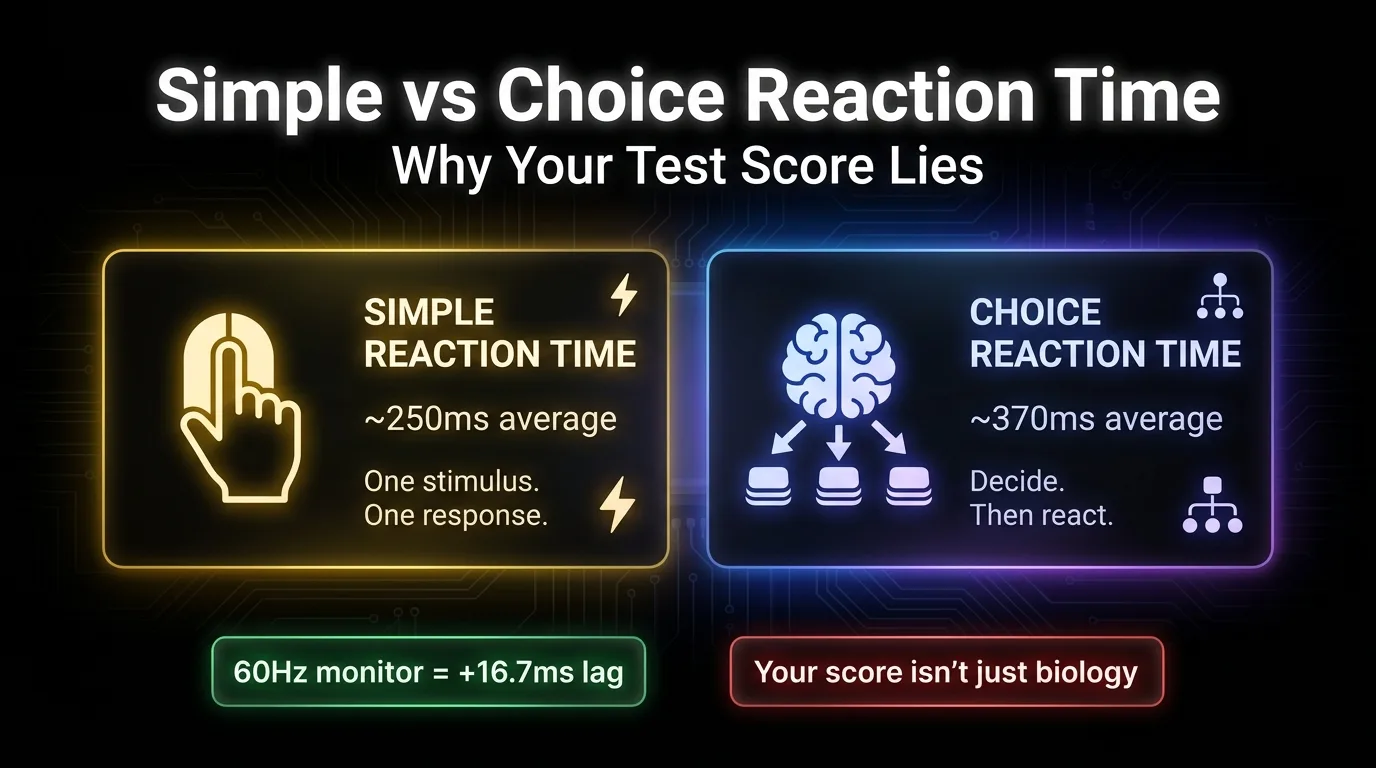
Most reaction time tests measure simple reaction time: one stimulus, one response. But in gaming and real life, you're almost always dealing with choice reaction time, where your brain has to decide before it can act. That decision adds real milliseconds. And your monitor adds more. Here's what your score actually measures and what it doesn't.
Simple vs Choice Reaction Time: What's the Difference
Simple reaction time is the gap between a single expected stimulus and a single predetermined response. You see the color change, you click. Nothing to identify, nothing to choose. Every standard browser reaction time test is built around this.
Choice reaction time is what your brain does when multiple stimuli are possible and each one requires a different response. In a firefight you're not waiting for one signal. You're identifying whether the blur is an enemy or a teammate, deciding where to aim, picking when to act. That identification and selection stage does not appear in your test score.
Dutch physiologist Franciscus Donders quantified this gap in 1868 using his subtractive method: measure a choice task, subtract the simple task baseline, and the remainder is the pure cost of discrimination and decision. His research put that cost at 40 to 100 milliseconds. Here's how the two types compare across age groups:
| Age group | Simple RT (SRT) | Choice RT (4-choice) | Decision gap |
|---|---|---|---|
| 20s | ~210ms | ~370ms | ~160ms |
| 40s | ~240ms | ~410ms | ~170ms |
| 60+ | ~285ms | ~460ms | ~175ms |
For a deeper look at how SRT shifts through your lifetime, see average reaction time by age.
Hick's Law: Why More Choices = Slower Reaction
William Edmund Hick formalized this in 1952. Ray Hyman independently confirmed it in 1953. The result became Hick's Law: reaction time increases logarithmically, not linearly, as choices increase.
The formula is RT = a + b × log₂(n+1). Here a is your baseline sensory-motor floor, the biological minimum you cannot go below. b is the time cost per additional bit of information your brain must process. n is the number of choices in front of you.
Each doubling of choices adds roughly 100 to 150 milliseconds for untrained people. Going from one option to two costs 100-150ms. From two to four costs another 100-150ms on top of that.
In an FPS you're not reacting to a single known signal. You're processing whether to peek or hold, identifying the target's position, choosing the right ability at the right time. Each decision layers on top of your raw sensory-motor speed. Your browser test score measures none of that overhead.
Why Your Browser Test Score Isn't the Full Picture
Three things sit between your benchmark number and your actual in-game speed.
The first is the test type. Browser tests measure simple reaction time only. Real gaming requires choice reaction time. Your 210ms SRT score is your floor, not your in-game ceiling. A typical 4-choice gaming scenario puts real reaction time closer to 370ms.
The second is display hardware. A 60Hz monitor adds 16.7ms of display lag per frame. A 240Hz monitor brings that to 4.2ms. That's roughly 10ms difference in your test score from the monitor alone, nothing to do with your biology.
The third is input lag. A 125Hz mouse reports its position every 8ms. A 1000Hz gaming mouse drops that below 1ms. Combined with monitor lag, total hardware latency on a standard setup easily adds 15-20ms to every result you see.
Some players claim sub-100ms in-game reaction times. Game engines use input prediction and frame pre-rendering that honest browser tests do not have. Treat those figures as claimed, not measured.
Can You Actually Improve Your Reaction Time
Training affects CRT far more than SRT. Systematic reviews of visual training methods, stroboscopic training and light-board drills included, show CRT improvements of 5 to 27 percent. SRT improvements from the same training are much smaller because SRT is closer to your biological floor.
The mechanism follows what Hick's Law implies: practice flattens the b slope. Experienced players have seen specific scenarios so many times that those situations no longer register as choices. The brain converts deliberate decision-making into a retrieved association, so a 10-choice scenario costs almost no extra time once it is fully automatic.
Research supports this. Gamers in studies averaged 243.9ms on benchmark tests versus 307.2ms for non-gamers. Professional CS and Valorant players regularly achieve choice reaction times under 300ms for complex in-game tasks, not by having faster raw SRT, but by reducing how much of each situation still requires active decision-making. The Aim Trainer builds exactly this kind of scenario-specific automaticity.
One thing that limits improvement is the speed-accuracy tradeoff. The Drift-Diffusion Model describes how your brain accumulates evidence until it crosses a confidence threshold, then fires a response. Rushing lowers that threshold, which speeds up reaction time but increases errors. False starts on reaction tests are the clearest version of this: you fire before the signal because you anticipated it, bypassing the evidence stage entirely.
What Your Score Actually Means
If you scored 200 to 250ms, that is a normal SRT result. It is not a direct measure of your gaming performance. Your actual in-game reaction adds choice overhead on top of this floor.
If you scored 150 to 200ms, that is fast SRT. It still does not equal in-game CRT. The gap between your browser score and your real gaming reaction is not a flaw in the test. It is the decision cost, and it is the part you can train down.
Your SRT sets the floor. Everything above it is decision overhead. Knowing the difference tells you which part to focus on. To see where your number ranks overall, check our good reaction time guide for the full tier breakdown.
Frequently Asked Questions
What is the difference between simple and choice reaction time?
Simple reaction time measures how fast you respond to a single stimulus with one response. Choice reaction time measures how fast you respond when you have to identify which stimulus appeared and select the correct response for it. Choice reaction time is consistently 100-150ms slower because of the added decision step.
Do reaction time tests actually measure gaming performance?
Not directly. Most browser tests measure simple reaction time. Real gaming involves choice reaction time, which adds a decision cost on top of your baseline speed. Your browser score shows your sensory-motor floor, not your in-game reaction speed.
Does my monitor affect my reaction time score?
Yes. A 60Hz monitor adds 16.7ms of display lag per frame. A 240Hz monitor reduces that to 4.2ms. That's roughly a 10ms difference in your test score from hardware alone, completely separate from your biology.
Can you train choice reaction time?
Yes, and it responds to training better than simple reaction time. Visual training methods improve CRT by 5-27% in studies. The mechanism is that practice flattens the Hick's Law slope, converting deliberate decisions into automatic responses that cost almost no extra time.
Want to know your simple reaction time baseline? Take the free Reaction Time Test on ToolsBracker. No signup, instant results, works in any browser.
Free, no signup, results in seconds.
Take the Reaction Time Test