What Is the Average Typing Speed? WPM Reference Guide
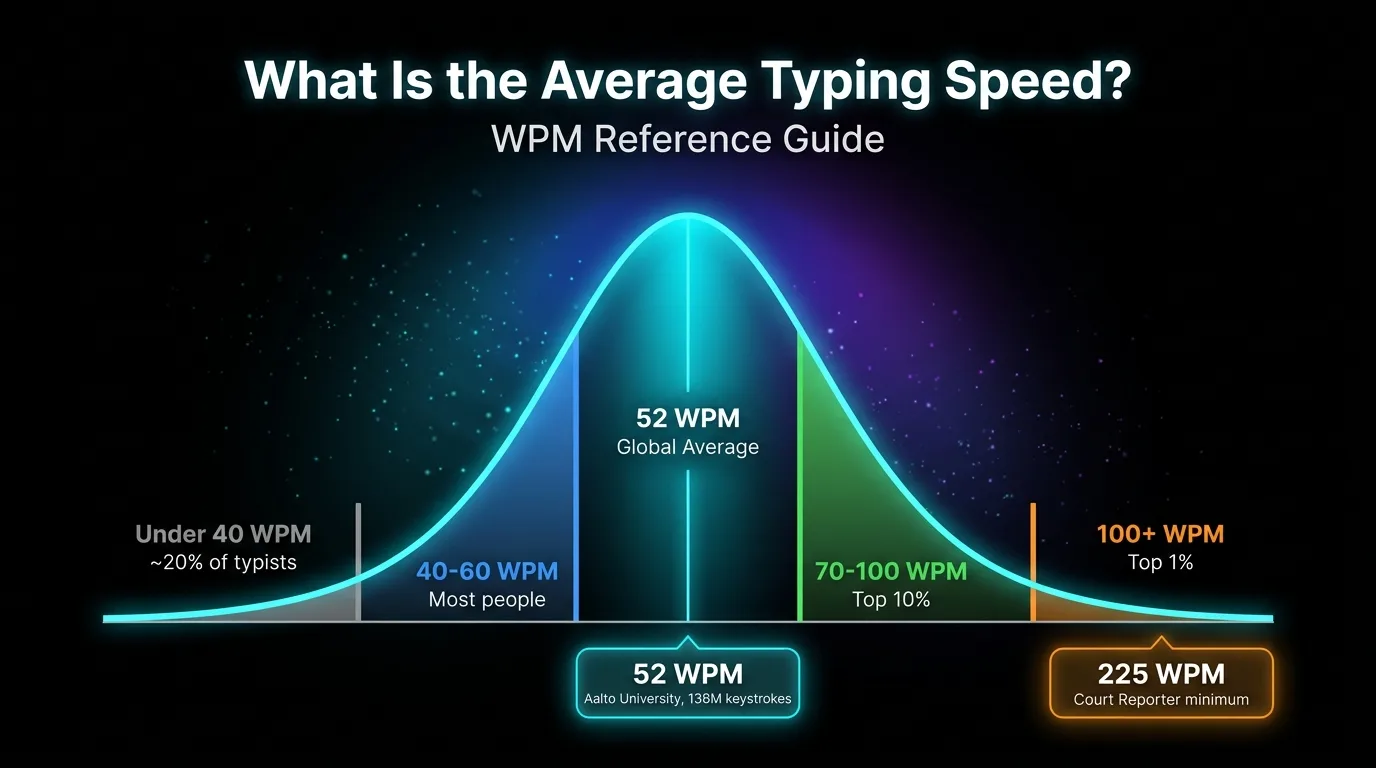
The global average typing speed is 52 WPM, based on the Aalto University and Cambridge 2018 study that analyzed 136 million keystrokes from 168,000 volunteers across 200 countries. The commonly cited 40 WPM figure is not a population average. It is a civil service hiring floor set in the late 19th century, not from modern measurement. Here is the full population breakdown and what your score actually means relative to everyone else.
The Real Global Average: What the Data Shows
The 40 WPM number you see on job postings and typing tutor sites is a minimum threshold, not a midpoint. The Aalto University and Cambridge 2018 study by Dhakal, Feit, Kristensson, and Oulasvirta collected 136 million keystrokes from 168,000 volunteers across 200 countries and found the actual global average at 52 WPM. That is 30% above the number most employers still use as their bar. The study, led by Antti Oulasvirta, is the largest population-level analysis of typing behavior ever published.
Independent data from TypeLit.io, drawn from over 30,000 real users, puts the mean at 51.8 WPM and the median at 49.7 WPM. Two independent sources converging that close is the strongest signal you will get outside a controlled lab.
Platform design creates real distortion in reported averages. Monkeytype shows around 62 WPM across its user base because it draws from a limited pool of common words, skips punctuation, and lets users move past errors rather than correcting them. TypeRacer scores run lower because it pulls from literary passages with complex punctuation and halts the test on each uncorrected mistake. Your score shifts depending on where you test, not just how fast your fingers move. A standardized typing speed test using random words with punctuation gives the most honest number.
Where You Fall in the Population Distribution
The distribution is not a smooth bell curve. It clusters. The 40-50 WPM range holds 22.3% of all typists, making it the single most populated band. Roughly 65% of people land somewhere between 40 and 80 WPM. The upper tiers thin out quickly.
| WPM Range | % of Typists | What It Means |
|---|---|---|
| Under 40 WPM | ~20% | Below civil service baseline |
| 40-60 WPM | ~45% | Average range, most populated |
| 60-80 WPM | ~25% | Above average |
| 80-100 WPM | ~7% | Skilled typist |
| 100+ WPM | ~1-1.3% | Elite territory |
| 120+ WPM | ~0.1% | World class |
Only 1 in 100 people types above 100 WPM. The gap between 80 WPM and 100 WPM is harder to close than the gap between 40 WPM and 60 WPM, because progress in the upper range requires eliminating errors rather than just moving faster. Above 7.3% of the population sits at 80 WPM or higher. Most people who consider themselves fast typists are in the 60-80 range, which is genuinely fast relative to the general population but still well below the elite cutoff.
Why 40 WPM Became the Standard
In 1888, Frank Edward McGurrin won a public typing contest by defeating a competitor who relied on visual search-and-strike. McGurrin typed without looking at the keyboard, using all ten fingers anchored to the home row. The victory established touch typing as the occupational standard for the emerging clerical economy and gave secretarial schools a performance target to train toward.
Early 20th century office expansion needed a measurable filter for hiring clerical workers at scale. Forty WPM became that filter. Civil service systems codified it, including the California Department of Human Resources CalHR, which still lists it as the pass/fail threshold for entry-level clerical positions in state government.
By the 1940s, professional secretaries averaged 50-60 WPM on manual typewriters, working against key mechanisms that required noticeably more force per keystroke than anything sold today. Modern keyboards with lighter switch actuation and full n-key rollover let typists achieve higher speeds with less physical effort. The actual average moved up. The official minimum did not, because civil service statutes, union contracts, and standardized job description templates do not update in response to hardware improvement.
The cost of that inertia is measurable. A typist at 70 WPM saves roughly 30 hours per month compared to one at 40 WPM in text-heavy communication work. That gap compounds across a team and becomes significant at the organizational level within a year.
Touch Typing vs Hunt and Peck: The Real Gap
A 2016 study by Logan, Ulrich, and Lindsey at Vanderbilt University found that 90% of typists use nonstandard self-taught hybrid methods rather than proper 10-finger touch typing. Among participants who identified themselves as touch typists, 58% were actually using nonstandard techniques when their keystrokes were analyzed.
The performance gap was smaller than most people assume. Touch typists averaged 80 WPM. Those using self-taught nonstandard methods averaged 72 WPM. Years of high-volume practice had built compensatory habits in the hybrid group that partially closed the gap.
That gap widens at higher speeds. Hunt and peck has a physical ceiling around 70-75 WPM because of Fitts's Law: large, inefficient finger movements across the keyboard take time that the nervous system cannot compensate for past a certain pace. Above 60 WPM, 10-finger mechanics scale more efficiently because each finger travels shorter, more predictable distances. The touch typing superiority becomes most pronounced exactly where improvement matters most. For what counts as a good WPM at each skill tier, that breakdown explains where the thresholds sit.
How Platform Scores Skew the Average
The WPM formula is total characters typed divided by five, divided by minutes elapsed. Five characters is the standardized word unit, counting spaces and punctuation as characters. Gross WPM counts everything typed. Net WPM, the number used in professional recruitment, subtracts a one-word penalty per uncorrected error.
Corrected errors carry a hidden cost that net WPM understates. Breaking rhythm to backspace, making the correction, and reaccelerating takes real time that does not get captured as a formal penalty. Timothy Salthouse's inter-key interval research showed this recovery cost compounds over longer test sessions, which explains why a sustained 5-minute test score is often noticeably lower than a 60-second burst result on the same platform.
Burst tests in the 15-60 second range measure mechanical ceiling under ideal conditions. Sustained tests over 5-10 minutes measure real output under fatigue. If the number matters for professional or hiring context, a full-minute minimum on random words with punctuation enabled gives the most accurate baseline.
Mobile vs Desktop: The 16 WPM Gap
Aalto University's 2019 follow-up study of 37,370 users measured the global mobile touchscreen average at 36.2 WPM. Against the desktop average of 52 WPM, that is a 16 WPM shortfall. The cause is not screen size.
Physical keyboards build procedural motor memory through thousands of consistent keystrokes on a fixed, tactile surface. Touchscreens shift with hand position, offer no physical anchoring, and provide no tactile feedback. Those differences prevent the deep keystroke pattern encoding that physical keys produce over time.
Two-thumb typing is the method 74% of mobile users rely on and averages 38 WPM. Swipe typing runs 15% faster for older adults and reduces errors by 27%. Autocorrect adds roughly 9 WPM on average by catching mistakes before they register in the score. Word prediction tends to slow users down rather than help them, because scanning the suggestion bar and selecting from it costs more attention than simply typing the next word.
Professional Benchmarks by Role
Different jobs demand different WPM floors, and the spread between entry-level and specialist roles is wide. Context matters: accuracy requirements vary as much as speed requirements do.
| Role | Required WPM | Notes |
|---|---|---|
| General office worker | 40-50 WPM | Entry level |
| Admin / receptionist | 50-60 WPM | Standard hire |
| Medical transcriptionist | 70-100 WPM | Accuracy critical |
| Data entry professional | 60-80 WPM | Volume dependent |
| Executive / legal secretary | 60-80 WPM | Above average |
| Court reporter (NCRA RPR) | 225 WPM min | Stenotype chording |
Court reporters work under the National Court Reporters Association Registered Professional Reporter credential, which requires 225 WPM at 95% accuracy. They use stenotype keyboards where a single chord motion enters a full syllable rather than an individual character. That physical mechanic is a different skill from keyboard typing, closer to a trained musical performance than a speed test. For how these professional numbers compare across life stages, average typing speed by age covers the demographic picture.
Frequently Asked Questions
What is the average typing speed?
The empirical global average is 52 WPM, based on the 2018 Aalto University and University of Cambridge study by Dhakal, Feit, Kristensson, and Oulasvirta, which analyzed 136 million keystrokes from 168,000 volunteers across 200 countries. The commonly cited 40 WPM figure is a civil service hiring floor from the late 19th century, not a modern population measurement.
Is 40 WPM a good typing speed?
40 WPM meets the civil service minimum threshold but sits below the real population average of 52 WPM. It is adequate for basic office tasks but places you in the bottom 20-25% of active computer users. Most professional hiring now expects 50-60 WPM or higher for roles that involve regular text work.
What percentage of people type over 100 WPM?
Only 1 to 1.3% of the general population types above 100 WPM. Above 120 WPM is roughly 0.1% of typists, which is world-class territory. The large majority of people, around 65%, land between 40 and 80 WPM.
Why is my Monkeytype score higher than my TypeRacer score?
Monkeytype uses a limited set of common words without capitalization or punctuation and allows users to move past errors without correcting them, which inflates scores. TypeRacer uses literary passages with complex punctuation and stops your test on each uncorrected error. Both measure real speed but under very different conditions. Net WPM on a standardized test with random words is the most reliable benchmark.
What is the average mobile typing speed?
The global average for touchscreen typing is 36.2 WPM, based on an Aalto University 2019 study of 37,370 users. Two-thumb typing, which 74% of mobile users rely on, averages 38 WPM. Mobile typing runs roughly 25-30% slower than the desktop average of 52 WPM, primarily because touchscreens cannot build the same motor memory as physical keyboards.
Does switching to Dvorak increase typing speed?
Research found no statistically significant WPM increase when switching from QWERTY to Dvorak after the learning period, despite Dvorak requiring 62% less finger movement across the keyboard. The reduced movement does lower hand strain during long sessions, but it does not translate into measurable raw speed gains for most typists who already have established QWERTY muscle memory.
Curious where your WPM lands on the distribution curve? Take the free Typing Speed Test on ToolsBracker. No signup, instant results, and you will see exactly what percentile you are in.
Free, no signup, results in seconds.
Take the Typing Speed Test