Color Blind Test: Types, How They Work, and What to Expect
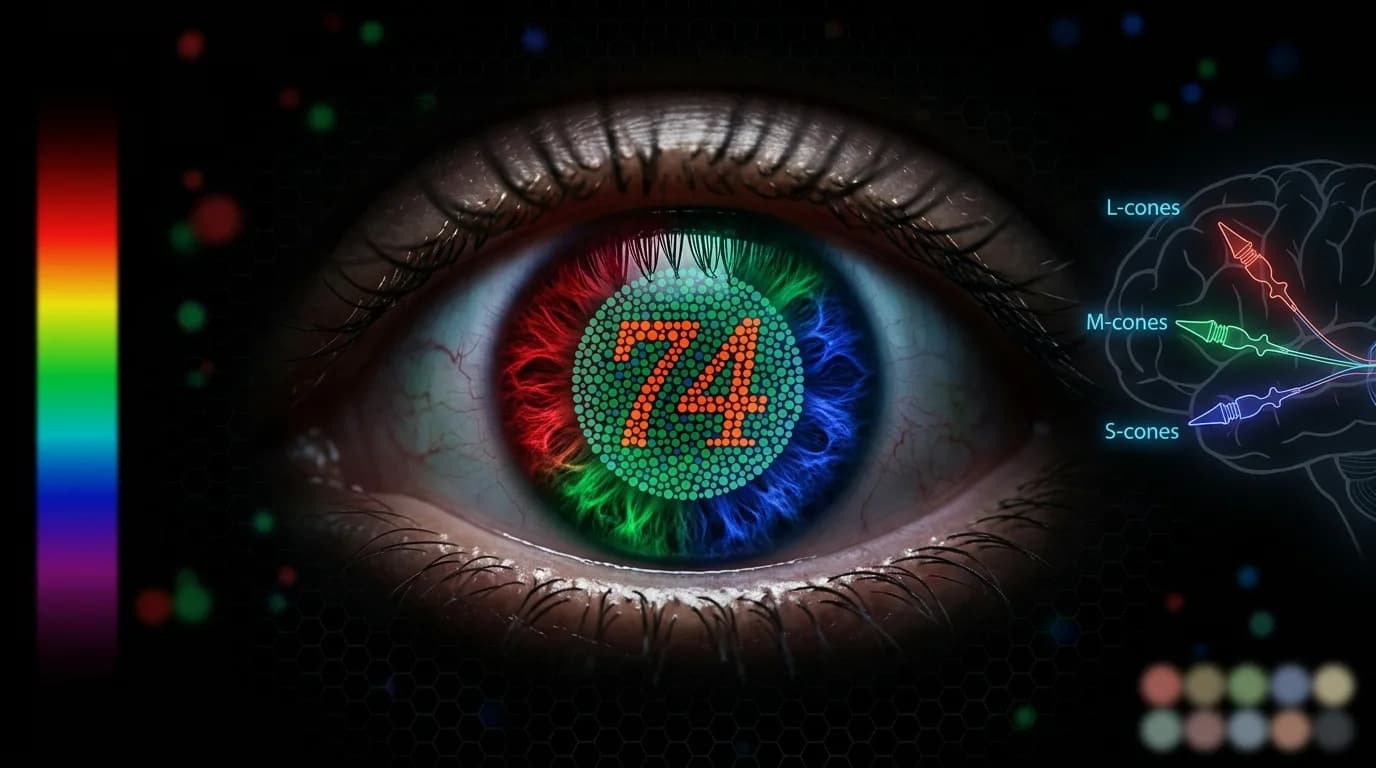
A color blind test checks whether your eyes can distinguish colors normally. Color vision deficiency affects about 8% of men and 0.5% of women. The most common type is red-green color blindness. Online tests like the Ishihara plate test give a good initial indication, though clinical tests are needed for a formal diagnosis. You can take a free color blind test right here on ToolsBracker.
What Is Color Blindness?
Color vision deficiency means your eyes don't process certain wavelengths of light the way most people's do. Your retina has three types of cone photoreceptors: red (long-wave), green (mid-wave), and blue (short-wave). When one or more of these cone types are missing or don't function correctly, certain color pairs become genuinely hard to separate.
Most color blindness is inherited and carried on the X chromosome, which is why it affects about 8% of men but only 0.5% of women. Women can carry the gene without having the condition themselves, meaning it can skip generations before showing up again.
Red-green color blindness is by far the most common form. It doesn't mean red and green look identical, but certain shades become nearly indistinguishable depending on lighting and context. Blue-yellow color blindness, which creates confusion between blue, yellow, and some greens and purples, is rarer.
Complete color blindness, where the world appears only in shades of gray, is extremely rare. The vast majority of people with CVD can still see color. They just struggle with specific combinations that most people find obvious.
Types of Color Blind Tests
Not all color blind tests work the same way. Each one is designed to detect or measure different aspects of color vision, and some are far more accurate than others.
Ishihara Plate Test
Developed in 1916 by ophthalmologist Shinobu Ishihara, this is the most widely used color vision test in the world. You look at circular images made of colored dots, with a number or shape hidden inside the pattern.
If you have red-green color blindness, you'll see a different number than someone with normal vision, or nothing at all. Ishihara plates have detection limitations depending on the type of CVD. For a full accuracy breakdown see the EnChroma color blind test guide.
You can take the free Ishihara-style color blind test on ToolsBracker right now, no account required.
Farnsworth-Munsell 100 Hue Test
The Farnsworth-Munsell 100 hue test takes a completely different approach. You arrange a series of colored caps along a continuous spectrum, and errors in the arrangement reveal which part of the color range you struggle with.
This test measures severity, not just presence. It's used in professional settings like aviation and graphic design to determine how significantly your color vision is affected and in which direction.
Anomaloscope
The anomaloscope is the clinical gold standard for diagnosing color vision deficiency. You adjust a mixture of red and green light until it matches an orange standard light, and the precise adjustments you make reveal your exact cone sensitivity.
The device costs around $18,000 and requires a trained optometrist to administer. You won't find one at a GP's office.
Online Color Blind Tests
Online color blind tests are fast, free, and accessible on any device. They use the Ishihara method and give a strong first indication of whether you might have a color vision issue worth investigating.
They can't replace a clinical diagnosis. Screen brightness, calibration, and display color profiles all affect how the plates look. For a confirmed result, the National Eye Institute recommends a full clinical eye exam. ToolsBracker's free color blindness test is a solid starting point before deciding whether to see a specialist.
For a detailed look at one of the most popular online options, read our EnChroma color blind test review.
Types of Color Blindness Explained
Color blindness isn't one condition. The type you have depends on which cone is affected and whether it's absent entirely or just functioning below normal. Here's how the main categories break down:
| Type | Cone Affected | Colors Confused |
|---|---|---|
| Protanopia | Red (long-wave) | Red and green |
| Deuteranopia | Green (mid-wave) | Red and green |
| Tritanopia | Blue (short-wave) | Blue and yellow |
| Monochromacy | All cones | All colors |
Protanopia and deuteranopia are the two main forms of red-green color blindness. Milder versions, protanomaly and deuteranomaly, involve cones that work but aren't tuned correctly. Tritanopia is rarer and can appear with age or as a side effect of certain medications. Monochromacy, where all color perception is absent, is extremely uncommon.
EnChroma glasses are sometimes marketed as a way to help people with CVD see more vivid colors. They work for some types of red-green color blindness but don't correct the underlying condition and aren't effective for everyone.
What Is the Backwards Color Blind Test?
A reverse color blind test flips the standard format so only people with color vision deficiency can see the hidden number. For the full explanation see the reverse color blind test guide.
Who Needs a Color Blind Test?
Children are typically screened between age 4 and 5, either at school or during a pediatric checkup. Catching color blindness early helps teachers adapt learning materials, since many early classroom activities rely on color identification and matching. Online color blind tests for preschoolers work well for any child old enough to identify numbers.
Many military roles and aviation jobs have strict color vision standards. FAA color vision requirements were updated in January 2025. New commercial pilot applicants now need to pass the CAD test or Rabin Cone Contrast Test for unrestricted certification, replacing the Ishihara as the accepted standard. Military requirements vary by role and service branch.
For everyone else, an online test is the obvious first step if you've ever wondered whether you see colors the same way other people do. Most adults with mild CVD have adapted over time without knowing it, and plenty find out by accident during a routine eye exam. If the numbers on the plates look wrong to you, that's worth following up.
More Free Sensory Tests Worth Trying
ToolsBracker has more free sensory and cognitive tests worth trying. Check the free hearing age test to see how your hearing holds up at high frequencies. For a different kind of challenge, the chimp test benchmarks your short-term visual memory against chimpanzee scores.
If you want to see where your memory scores stack up against everyone else, the chimp test average score breakdown shows what separates a typical result from an exceptional one.
Frequently Asked Questions
How do I know if I am color blind?
Take an Ishihara plate test online. If you struggle to see numbers in the dot patterns you may have color vision deficiency. An optometrist can confirm with a clinical test.
What are the different types of color blind tests?
The main types are the Ishihara plate test, the Farnsworth-Munsell hue test, and the anomaloscope. Online tests are based on the Ishihara method and are free and instant but not clinically accurate.
Are online color blind tests accurate?
Online tests are good for initial screening but not clinically accurate. Screen calibration and brightness affect results. Ishihara-based tests have detection limitations depending on the type of CVD. See an optometrist for a formal diagnosis.
Can kids take a color blind test?
Yes. Online tests work for children old enough to identify numbers, typically age 4 and above. Schools often screen around age 5. Early detection helps with classroom accommodations.
Does the military test for color blindness?
Yes. Many military and aviation roles require specific color vision standards. The FAA updated requirements in January 2025, now requiring the CAD test or Rabin Cone Contrast Test for new commercial pilot certification.
How often should you take a color blind test?
For most people, once in childhood and once as an adult is enough unless you notice changes in how you perceive colors. Color blindness is usually inherited and stable, though acquired CVD can develop with age, medication, or eye disease. If colors start looking different than they used to, see an optometrist.
Ready to check your color vision right now? Take the free Color Blind Test on ToolsBracker. No signup, instant results, works on any device.
Free, no signup, results in seconds.
Take the Color Blind Test