Does Aim Training Actually Work? What the Science Says
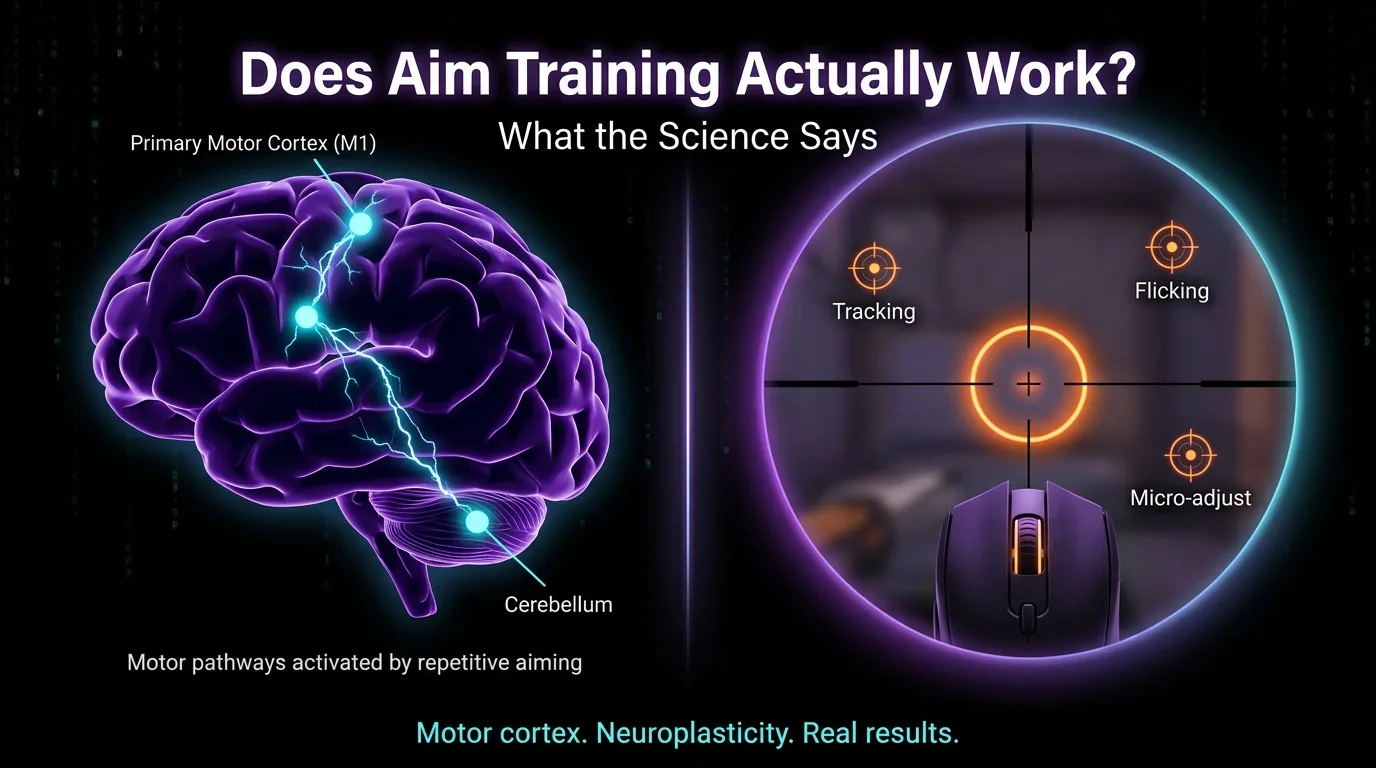
Yes, aim training works. Peer-reviewed research confirms that deliberate practice on component aiming skills produces measurable improvement in as little as 3 to 5 days. The science behind it involves neuroplasticity in the primary motor cortex (M1). But the type of training matters as much as the quantity. Here is what the research actually says.
The Science Behind Aim Training
When you repeatedly practice aiming, you are engaging your primary motor cortex (M1), the region of the brain responsible for precise motor control. Repetitive aiming induces persistent encoded neural activations that make difficult movements more automatic over time. This is neuroplasticity applied directly to gaming performance.
C. Shawn Green at the University of Wisconsin-Madison and Daphné Bavelier at the University of Geneva established that action video game training produces learning that generalizes well beyond the specific training task. This is unusual in cognitive training, where most improvements stay specific to the trained activity. The key mechanism is a "learning to learn" effect, where players become better at extracting relevant information from new environments and making faster probabilistic decisions under pressure.
A 2021 study by Adam J. Toth and Mark J. Campbell at the University of Limerick, conducted at the Esports Science Research Lab (ESRL) at Lero (The Irish Software Research Centre), specifically studied flicking, one of the core aiming skills in FPS games. Their finding was direct: deliberate training on this single component skill significantly improved performance across all expertise levels, from beginners to advanced players. Published in Frontiers in Sports and Active Living, this research provides the most direct evidence that structured aim training transfers to real in-game performance.
Which Type of Aim Does Training Actually Improve?
Not all aiming is the same. Understanding which type your game demands is the difference between effective training and wasted time.
| Aim Type | What It Is | Primary Games |
|---|---|---|
| Static clicking | Hitting stationary targets fast | Valorant, CS:GO |
| Dynamic clicking | Hitting targets that move briefly | Valorant, CS:GO |
| Smooth tracking | Keeping crosshair on a continuously moving target | Overwatch |
| Reactive tracking | Quick response to sudden direction changes | Overwatch, high TTK games |
| Target switching | Fast transitions between multiple targets | CoD, Apex Legends |
Most browser-based aim trainers, including ToolsBracker's free aim trainer, cover clicking scenarios and target switching effectively. If you mainly play Valorant or CS:GO, those scenarios map directly to what you need in-game. For tracking scenarios common in Overwatch, dedicated platforms like KovaaK's offer more specific practice environments.
How Long Does Aim Training Take to Work?
This is what every gamer actually wants to know. The Toth et al. 2021 study found measurable performance improvements in as little as 3 to 5 days of consistent training with just 10 minutes per session. That single finding is the most important number in aim training research, and almost nobody cites it.
Methodology matters as much as duration. Research shows that training with variability, using different targets, distances, and movement patterns, produces better transfer to real games than grinding the same scenario thousands of times. Repetitive single-scenario training builds a specificity that does not travel outside that exact drill. You get great at the drill. The game stays the same.
Practical guidelines from the research:
- 10 to 15 minutes per day is enough. More time does not produce faster improvement and often just creates fatigue.
- Vary your scenarios. Switch between clicking, tracking, and target switching drills rather than grinding one map for hours.
- Consistency beats intensity. 10 minutes every day outperforms a 2-hour session on weekends every time.
- Low DPI between 400 and 800 gives more precise control. High DPI amplifies small hand movements and turns minor tremors into missed shots.
- Your eDPI, which is DPI multiplied by your in-game sensitivity, is the universal calibration standard professionals use to compare and replicate settings across games.
- A 1000Hz polling rate on your mouse reduces input lag and makes every training session more responsive to small corrections.
The One Factor Most Gamers Ignore: Sleep
Howard C. Nusbaum at the University of Chicago researches how sleep affects skill consolidation, and his findings have a direct implication for every aim training session you do. During sleep, the brain encodes and protects motor patterns learned during practice, helping them generalize to new situations. The actual skill transfer happens while you are not playing.
A focused 10-minute aim training session followed by adequate sleep is more effective than a 2-hour grind followed by poor rest. The brain needs that consolidation window to make the practice stick. Gamers who train deep into the night on poor sleep are leaving real improvement on the table no matter how many hours they log.
Sleep also affects your raw reaction speed, which compounds with aim improvement to determine your actual ceiling in-game. Read our average reaction time by age guide to see how fatigue directly impacts your baseline speed and why recovery is a core part of any training plan.
Is Aim Training Worth It?
Yes, with the right approach. The research is consistent: structured aim training produces genuine, measurable improvement in real-game aiming performance. Dr. Seth Jenny at Slippery Rock University, who serves as a performance advisor for KovaaK's professional aim training software, has documented the effectiveness of deliberate practice in competitive esports contexts. A named academic at a named institution advising the most widely used aim training platform is one of the strongest endorsements this field has.
Professional players are widely known to use aim trainers as part of their daily warmup routines, and the research explains exactly why that habit produces results.
The conditions that make it work:
- Train consistently with daily short sessions rather than occasional long ones.
- Match your training type to your game: clicking for CS:GO and Valorant, tracking for Overwatch, target switching for Apex Legends and Call of Duty.
- Use variable scenarios rather than repeating the same drill on loop.
- Prioritize sleep so the motor patterns from each session actually consolidate overnight.
- Set your DPI and sensitivity correctly before you start training so you are not building precise habits at the wrong sensitivity.
Aim and reaction time are connected at a fundamental level. Read our how to improve reaction time guide for the complementary skills that make aim training more effective over time.
Frequently Asked Questions
Does aim training actually work?
Yes. Peer-reviewed research from the University of Limerick's Esports Science Research Lab confirms that deliberate practice on component aiming skills like flicking produces measurable improvement across all skill levels. Performance gains are observable in as little as 3 to 5 days of consistent 10-minute daily sessions.
How long does it take for aim training to show results?
Research by Toth et al. 2021 found significant improvement in as little as 3 days with just 10 minutes of daily practice. Consistency matters more than session length. Daily short sessions outperform occasional long ones every time.
How long should you aim train per day?
Research suggests 10 to 15 minutes of focused deliberate practice is sufficient for improvement. More training does not necessarily mean faster results. Varying your scenarios produces better transfer to real games than grinding one drill for hours.
Does aim training transfer to real games?
Yes. Research by Green and Bavelier at the University of Geneva found that action game training produces learning that generalizes beyond the specific training task, an effect they attribute to a "learning to learn" mechanism. Training on component skills like flicking transfers measurably to actual in-game performance.
What is the best DPI for aim training?
Low DPI between 400 and 800 is generally recommended for FPS games. High DPI amplifies small hand movements and reduces precision. Your eDPI, which is DPI multiplied by in-game sensitivity, is the universal calibration standard used by professional players to compare and replicate settings across different games.
Does sleep affect aim training results?
Yes, significantly. Research by Howard C. Nusbaum at the University of Chicago shows sleep is critical for motor skill consolidation. The brain encodes and generalizes motor patterns during sleep. Poor sleep after training sessions reduces the effectiveness of aim practice regardless of how long the session was.
Ready to test your current aim? Try the free Aim Trainer on ToolsBracker. No download, no signup, works in your browser. See where your clicking accuracy and target switching speed stands right now.
Free, no signup, results in seconds.
Take the Aim Trainer