Hearing Age Test: What It Is and What Your Results Mean
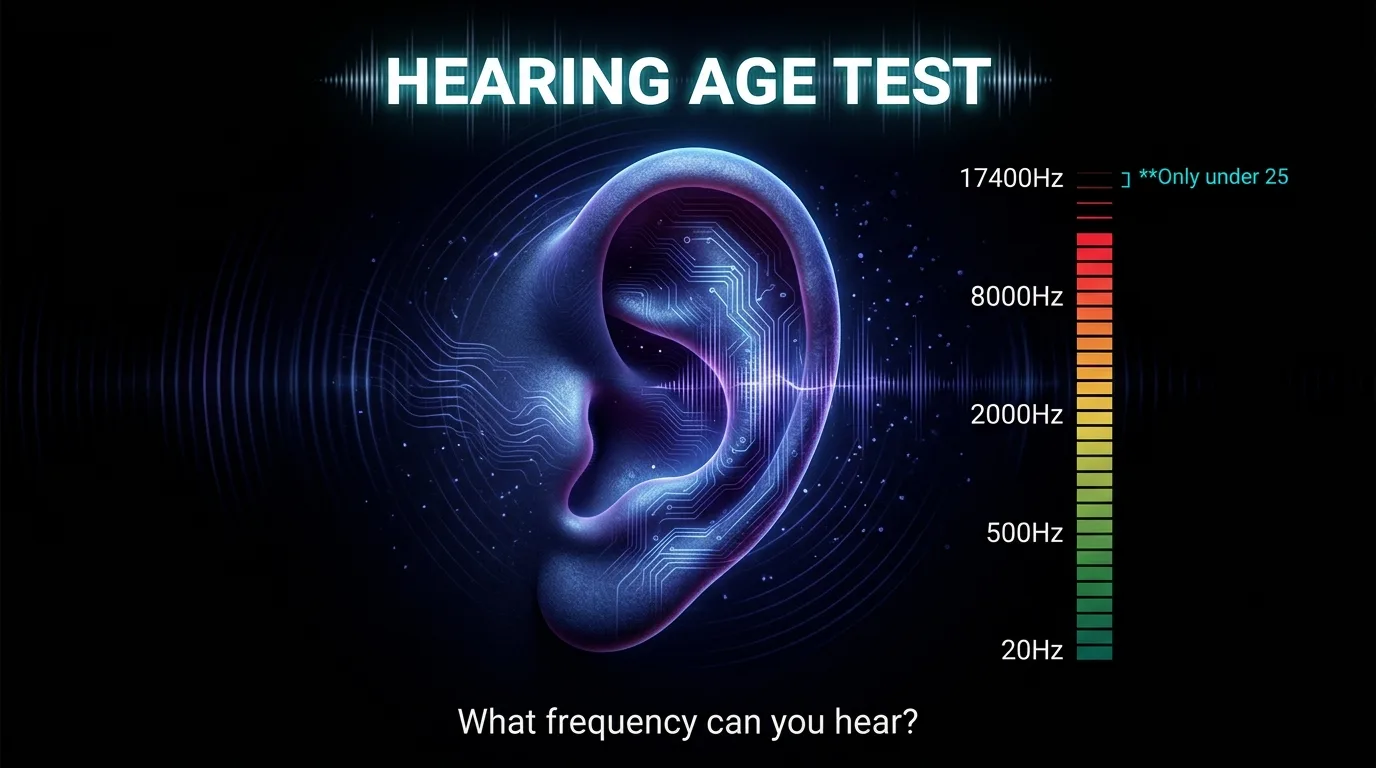
If you can still hear a 17,000 Hz tone clearly, your hearing is probably younger than you think. Most people start losing high-frequency sounds around age 18 without noticing. A hearing age test measures exactly where you sit on that scale by playing a series of tones from low to high, stopping when you can no longer detect them. Your result can be older or younger than your real age depending on noise exposure, genetics, and lifestyle.
Take the Hearing Age Test now to find out your hearing age in under two minutes. Use earbuds in a quiet room for the best result. Keep reading to understand what your score means.
What Is a Hearing Age Test?
The test plays tones at increasing frequencies. The highest frequency you can still hear indicates your approximate hearing age. Your result can differ significantly from your actual age, sometimes by decades.
Someone who worked around loud machinery for years may have the hearing age of someone two decades older. Someone who consistently protected their ears may hear better than most people their age. Sound is measured in Hz (frequency, how high or low a pitch is) and dB (loudness). Normal conversation sits at roughly 60 dB.
A hearing age that runs 10 or more years ahead of your real age usually means noise-induced damage has accumulated faster than it should. A hearing age matching or running younger than your chronological age suggests your ears have held up well relative to your peer group. The test does not diagnose anything on its own, but it gives you a concrete starting point.
Take the free hearing age test on ToolsBracker to find out your hearing age right now. No signup, instant results.
Normal Hearing Test Results by Age
Hearing test results by age follow a predictable pattern. The older you are, the lower your upper frequency limit tends to be. The table below shows typical hearing frequency ranges across age groups.
| Age Group | Typical Upper Frequency | Notes |
|---|---|---|
| Under 18 | Up to 20,000 Hz | Peak hearing range |
| 18-25 | Up to 18,000 Hz | Slight decline begins |
| 25-35 | Up to 16,000 Hz | Gradual high-frequency loss |
| 35-50 | Up to 14,000 Hz | Presbycusis progressing |
| 50-60 | Up to 12,000 Hz | Significant high-frequency loss |
| 60+ | Up to 8,000-10,000 Hz | Affects speech clarity |
These are approximate ranges. Individual variation is significant based on genetics, noise exposure history, and overall health. Hearing test frequency by age is a useful benchmark, but outliers in both directions are common.
The 2,000-8,000 Hz range matters most for speech comprehension. When decline reaches this band, following conversations in noisy environments becomes noticeably harder. If you want to see how other benchmarks shift with age, the average reaction time by age breakdown makes for an interesting comparison.
The Mosquito Tone: What Only Young People Can Hear
At exactly 17.4 kHz sits a frequency that splits the hearing world by age. Most adults over 25 simply cannot hear it. That inability is not a flaw; it is presbycusis, the natural age-related hearing decline that starts far earlier than most people expect.
In 2005, Howard Stapleton invented the Mosquito device, an anti-loitering machine that blasts this tone near shops and transit stops to discourage teenagers from gathering. The logic was simple: teenagers find the 17,400 Hz buzz uncomfortable, and adults cannot hear it at all.
Teenagers noticed this gap almost immediately. The Teen Buzz ringtone, built on the same 17.4 kHz frequency, spread through schools so students could receive texts in class without teachers noticing. A device designed to annoy teenagers became a secret communication channel because of the exact same hearing gap it was built around.
This is precisely what a hearing age test measures. If you can still hear the mosquito tone clearly, your hearing age puts you well below 25. Most people discover they can no longer hear it much sooner than they expected.
What Is Presbycusis?
Presbycusis is the medical term for age-related hearing loss. It is not a disease but a gradual natural process caused by changes in the inner ear, middle ear, and the nerve pathways that carry sound signals to the brain.
The World Health Organization reports that over 25% of people older than 60 have disabling hearing loss, defined as greater than 35 dB loss in the better-hearing ear. The WHO World Report on Hearing (2021) estimates over 1 billion young people are at risk of permanent hearing damage from unsafe listening habits.
Among Americans aged 65-74, approximately 1 in 3 experience hearing loss. By age 75 and older, nearly half have difficulty hearing. Men in their 50s tend to experience loss at a higher rate than women, though that gap closes as both groups age.
The effects of presbycusis extend beyond sound. Age-related hearing loss has been linked to increased cognitive load and social withdrawal in older adults. People with untreated hearing loss spend more mental energy processing speech, which leaves less capacity for other tasks. Catching a significant gap in your 40s or 50s gives you time to act before those downstream effects compound.
How to Protect Your Hearing
Any sound above 85 dB can damage hearing with prolonged exposure. Normal conversation is around 60 dB. A concert or nightclub typically hits 100-110 dB, well past the damage threshold in under two hours of exposure.
OSHA's workplace noise standard (29 CFR 1910.95) limits workers to 90 dB for 8 hours per day before mandatory hearing protection is required. Industries like construction, manufacturing, and live music regularly exceed that limit. Regular earplugs or earmuffs in these environments are not optional if you want to keep your hearing age low.
Volume is not the only factor. Duration matters equally. At 88 dB the safe exposure time halves. At 91 dB it halves again. Concert-level noise at 100 dB crosses the damage threshold in under 15 minutes without protection. Keeping the volume down on earbuds and headphones is one of the most practical things a younger person can do to slow their hearing age over time.
Presbycusis itself cannot currently be prevented. Noise-induced hearing loss, on the other hand, is entirely preventable with consistent ear protection from an early age. The National Institute on Deafness has detailed guidance on hearing protection strategies for every stage of life.
How Accurate Are Online Hearing Tests?
Online hearing age tests are effective screening tools. They give a reliable indication of your hearing frequency range, which is exactly what the hearing test age range benchmark is built on. They cannot replace a clinical audiogram from a licensed audiologist.
Accuracy depends heavily on what you use to listen. Earbuds give more reliable results than phone speakers because they seal closer to the ear canal and block more ambient noise. A quiet room gives better results than a noisy environment. These variables affect every online hearing test by age.
The WHO supports the hearWHO app as a validated screening tool for initial hearing checks. Try the free hearing age test on ToolsBracker using earbuds in a quiet room for the most accurate result. If you want to round out your sensory self-check, the free color blind test assesses color vision in under a minute with no signup.
When to See an Audiologist
An online hearing age test is a starting point, not a final answer. Some results point clearly beyond the screen.
If your hearing age runs more than 10-15 years ahead of your real age, that gap is worth investigating with a professional. If you frequently miss words in quiet settings, ask people to repeat themselves, or find that phone calls have become genuinely difficult, those real-world signals matter as much as any test result.
A clinical audiogram takes roughly 30-45 minutes. An audiologist plays a sequence of pure tones through calibrated headphones across a wider and more precise frequency range than any online test can accurately deliver. The result is plotted on an audiogram chart that maps hearing loss in decibels against frequency. From that chart, a specialist can confirm whether the loss is sensory, conductive, or mixed, measure its severity, and recommend whether intervention makes sense.
For most people, a clean result on an online test combined with no real-world symptoms is reassurance enough. When those two things do not match, the audiologist visit is the right next step.
Frequently Asked Questions
What is a hearing age test?
A hearing age test plays high-frequency tones to estimate how old your hearing is relative to your real age. The highest frequency you can hear indicates your approximate hearing age. A young person with healthy hearing can detect up to 20,000 Hz while most people over 60 can only hear up to 8,000-10,000 Hz.
What are normal hearing test results by age?
A healthy person under 18 can typically hear up to 20,000 Hz. By age 25 this drops to around 18,000 Hz and continues declining gradually. By age 60 and older most people hear up to 8,000-10,000 Hz. Significant variation exists between individuals based on noise exposure and genetics.
What is the mosquito tone and what age can hear it?
The mosquito tone is a 17.4 kHz frequency that most people over 25 cannot hear due to age-related hearing decline. Howard Stapleton invented a device using this tone in 2005 to deter teenagers from loitering. Teenagers adapted it into the Teen Buzz ringtone that adults and teachers could not hear.
What is presbycusis?
Presbycusis is the medical term for age-related hearing loss. It typically begins with high-frequency sounds and progresses gradually. Over 25% of people older than 60 have disabling hearing loss according to the World Health Organization. It cannot currently be prevented, unlike noise-induced hearing loss.
At what age does hearing start to decline?
High-frequency hearing decline can begin as early as age 18, though most people do not notice it until their 30s or 40s. The 2,000-8,000 Hz range matters most for speech clarity and tends to decline more noticeably from age 40 onward.
Are online hearing tests accurate?
Online hearing tests are effective for initial screening but cannot replace a clinical audiogram. Accuracy is affected by headphone type, room noise, and speaker quality. Using earbuds in a quiet room gives the most reliable results. The WHO supports validated screening apps as a first step before seeing an audiologist.
Ready to find out your hearing age? Take the free Hearing Age Test on ToolsBracker. Use earbuds in a quiet room for the most accurate result. No signup, instant results.
Free, no signup, results in seconds.
Take the Hearing Age Test