Highest CPS Ever Recorded: World Records and Limits
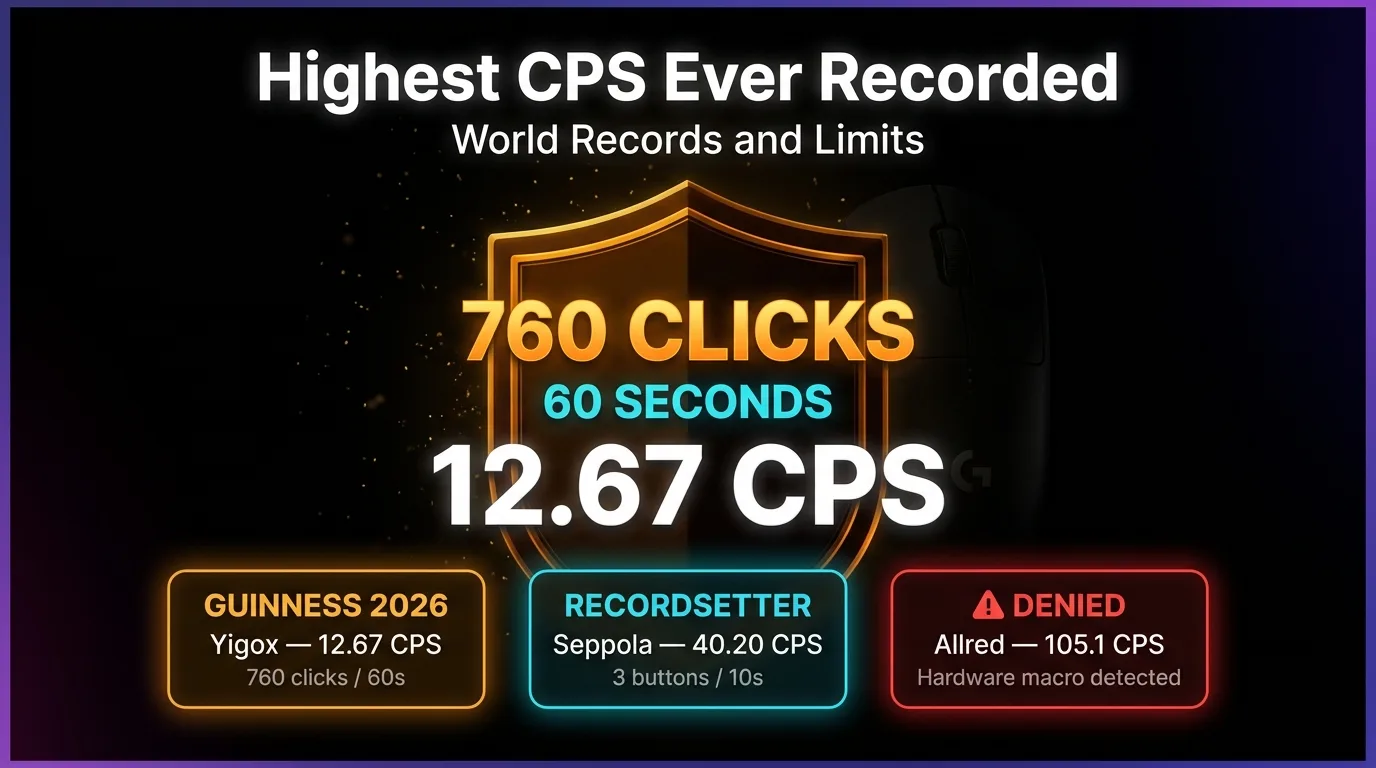
The official Guinness World Record for highest CPS belongs to Yiğit Arslan "Yigox", a professional Valorant player from Istanbul. He recorded 760 clicks in 60 seconds on February 10 2026, averaging 12.67 CPS. Several higher claims exist online but most are flagged as exploits or physically impossible. Here is every verified record and why the fake ones do not count.
The Official Guinness World Record
Yiğit Arslan, known online as "Yigox", set the official Guinness World Records title for most mouse clicks in 60 seconds at FUT House in Istanbul on February 10 2026. He hit 760 clicks in the allotted time, landing at 12.67 CPS. The record was established and sponsored by Logitech G, who set the minimum qualifying threshold at 750 clicks to ensure only genuine attempts reached the books.
Yigox used the Logitech G PRO X2 SUPERSTRIKE mouse, a piece of hardware built specifically for rapid-fire competitive gaming. As a professional Valorant player, he brings a background in precision motor control that goes well beyond casual clicking. His day job depends on clean, fast inputs under pressure.
The 60-second format is the hardest way to set a clicking record. Most viral speed claims online use 10-second windows, where you can sustain a burst effort before the nervous system catches up. At 60 seconds, CNS fatigue sets in well before the timer ends. Research by Bächinger et al. found that central nervous system motor slowing begins after just 10 seconds of maximal clicking, meaning Yigox had to maintain his rate through five cycles of cumulative fatigue. That is what makes 12.67 CPS over 60 seconds a genuinely impressive sustained number, not just a lucky burst.
RecordSetter Records: Seppola's Numbers
Before Guinness formalized the category, RecordSetter hosted the community's best attempts. Tom Andre Seppola from Honningsvåg, Norway, holds two of the most significant entries. On October 13 2010 he logged 830 clicks in 30 seconds for 27.67 CPS. Less than a month later, on November 12 2010, he pushed the 10-second format to 402 clicks for 40.20 CPS.
The key detail on Seppola's records: he was triple-triggering three mouse buttons simultaneously. Left click, right click, and middle or side button, all bound and firing together. The raw count reflects all three inputs, not single-button motor output. That technique is not comparable to the Guinness format, which standardizes on a single mouse button. RecordSetter has no such restriction, which is why its numbers look so much higher.
Seppola's records had predecessors. The RecordSetter progression ran from Peter Craig at 369 clicks to Lykac Spokas at 215 clicks before Seppola overtook both. The multi-button method he used was legal under RecordSetter rules, but it makes these numbers fundamentally incompatible with single-button benchmarks. He was measuring a different skill, measured the same way.
The Flagged Records: Why These Do Not Count
Three claims stand out as the most widely cited fake records online. Each was flagged or denied for a different reason.
Dylan Allred submitted 1,051 clicks in 10 seconds, which works out to 105.1 CPS, to RecordSetter on May 6 2015 from Las Vegas. RecordSetter denied it. The analysis showed hardware-level macros running on his Razer mouse. The giveaway is Inter-Tap Interval uniformity: human clicking has natural stochastic variability between clicks, small random fluctuations in the gap from one tap to the next. Macros and auto-clickers produce perfectly uniform intervals. The pattern is deterministic and it triggers anti-cheat detection immediately. Allred's submission showed exactly that pattern.
Nabi Khan claimed 50 clicks in 0.22 seconds, which comes out to 227.27 CPS. This one is flagged as physically impossible, not just suspicious. The exploit involved a double-click hardware trigger where the mouse registers two events per physical depression at the firmware level. That is not clicking speed. That is a hardware configuration producing phantom inputs.
Community compilations sometimes circulate a 614.1 CPS figure attributed to "butterfly drag clicking." This is biomechanically impossible as a voluntary motor act. No peer-reviewed motor science places the ceiling for any human finger technique anywhere near that number. The claim is unverified and should be ignored as a benchmark.
Want to know your real CPS? The CPS test on ToolsBracker gives you an accurate result in seconds.
What Is the Physical Limit of Human Clicking?
The short answer: healthy adults average 5.1-6.1 Hz in tapping tests. Elite esports players reach up to 7.4 Hz through trained feedforward processing. Claims above 14-18 CPS sustained with one finger push past the outer edge of verified human capability.
Ekşioğlu and İşeri documented what the decay curve actually looks like under sustained effort: a burst rate of 6.48 Hz in the first five seconds, declining to 5.02 Hz by the 30-second mark. That is not a small drop. It represents nearly a 23% speed loss during a single continuous effort. Your finger does not tire out. Your nervous system does.
The 60-second Guinness format exposes exactly what Bächinger et al. documented — CNS motor output throttles within the first 10 seconds of maximal effort, meaning the second half of Yigox's attempt was fought against his own fatigued nervous system. Wells recorded the first clinical use of finger oscillation to measure motor fatigability in 1908, and the basic finding has held: what slows you down is the brain, not the muscle.
| Technique | Documented CPS Ceiling |
|---|---|
| Regular clicking | 9 CPS |
| Jitter clicking | 18 CPS |
| Butterfly clicking | 30 CPS (burst) |
| Drag clicking | 70+ CPS (friction, not voluntary) |
Drag clicking deserves a separate note. The high numbers come from stick-slip friction between the finger and mouse surface generating rapid vibrations, not from motor cortex control. The clicks are real in the sense that the switch registers them, but the nervous system is not generating each one intentionally. It is incomparable to voluntary CPS and is banned on most competitive Minecraft servers for exactly that reason.
A Brief History of Clicking Records
The clinical study of finger tapping speed dates to Wells in 1908, the first documented use of finger oscillation as a measure of motor fatigability. The practice eventually migrated from neurology labs to internet forums, where RecordSetter gave competitive clicking its first dedicated leaderboard in the late 2000s. The RecordSetter era ran from scattered community attempts through the Seppola records of 2010, with no standardization on technique or button count.
That changed in 2026 when Logitech G sponsored the first officially adjudicated Guinness category for mouse clicks. The 750-click threshold, the 60-second format, and the hardware verification process created the first record that can actually be compared across attempts. Yigox's 12.67 CPS is the benchmark that counts. Everything before it was a different game under different rules. For context on what counts as a good CPS score relative to this record, the pillar post has the full benchmarks by skill level.
Frequently Asked Questions
What is the highest CPS ever recorded?
The official Guinness World Record belongs to Yiğit Arslan "Yigox" with 12.67 CPS, set on February 10 2026 in Istanbul with 760 clicks in 60 seconds. For burst records, Tom Andre Seppola recorded 40.20 CPS in 10 seconds on RecordSetter using three mouse buttons simultaneously. Several higher claims exist online but have been flagged or denied for exploit use.
Is 40 CPS humanly possible?
Not with a single button using voluntary clicking. Seppola's 40.20 CPS used triple-triggering across three mouse buttons simultaneously. Drag clicking can reach similar numbers through stick-slip friction but this is not comparable to voluntary motor control. Single-finger sustained records above 14-18 CPS are at the outer edge of verified human capability.
Why was Dylan Allred's record denied?
RecordSetter denied his 105.1 CPS claim because analysis showed hardware-level macros on his Razer mouse. His Inter-Tap Intervals were perfectly uniform, which is impossible for human clicking and characteristic of macro automation. Human clicking has natural stochastic variability between clicks. Macros do not.
What is the highest CPS possible with one finger?
Research by Ekşioğlu and İşeri shows human tapping peaks at 6.48 Hz in short bursts, declining to 5.02 Hz over 30 seconds. Elite esports players reach up to 7.4 Hz. Anything above 14-18 CPS sustained with one finger is at the outer edge of verified human capability. The limiting factor is CNS motor slowing, not muscle fatigue.
How do click test sites detect fake scores?
Legitimate platforms analyze Inter-Tap Intervals. Human clicking has natural random variability between clicks. Macros and auto-clickers produce perfectly uniform intervals that trigger anti-cheat detection immediately. Fake scores are also generated by scroll wheel bindings, JavaScript event loop exploits, and auto-clicker software.
Think you can beat the benchmark? Try the free CPS Test on ToolsBracker. No signup, instant results, works in any browser.
Free, no signup, results in seconds.
Take the CPS Test