Sequence Memory Test: Average Score and What It Actually Measures
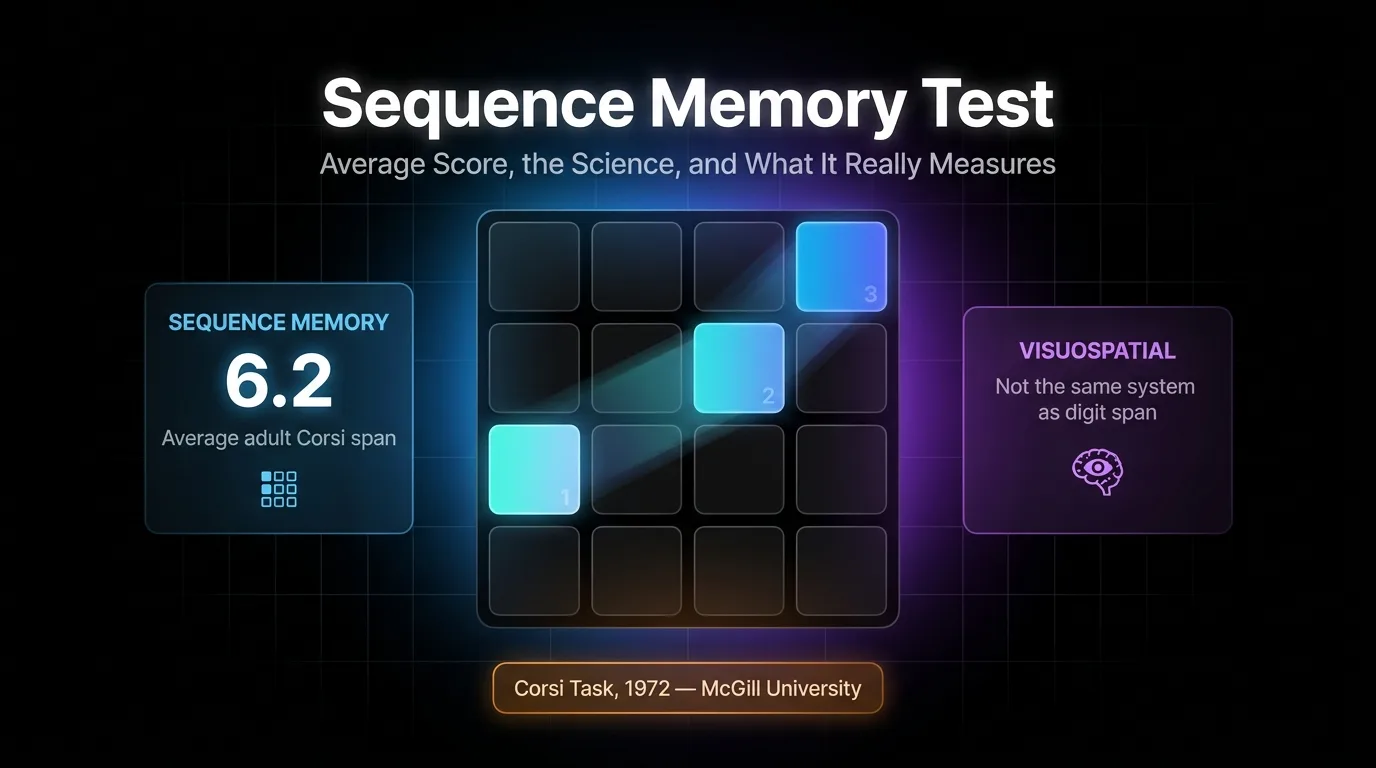
A sequence memory test does not measure the same thing as a digit span test. It targets your visuospatial sketchpad, the part of working memory that handles spatial patterns rather than words or numbers. The average adult Corsi span is 6.2, according to normative research by Kessels and colleagues in 2000. Here is what the test actually measures, what affects your score, and whether gaming genuinely improves it.
What Is a Sequence Memory Test
A sequence memory test measures dynamic visuospatial working memory, your ability to store and reproduce spatial patterns shown one step at a time. The format is usually a grid: a set of blocks light up in a specific order, and you repeat that order back. Each correct round adds another block, so the test keeps stretching until you reach the point where you can no longer hold the pattern.
The important part is what system this taps. It is not the same one a digit span test uses. Digit span leans on the phonological loop, the verbal side of working memory. Sequence memory leans on the visuospatial sketchpad instead. Alan Baddeley and Graham Hitch first proposed this split in Baddeley and Hitch's 1974 model, a tripartite picture of working memory with a Central Executive directing two helpers: the Phonological Loop for sound and language, and the Visuospatial Sketchpad for space and imagery.
This is fundamentally different from a digit span test, which measures verbal short-term memory instead. The two can pull apart in the same person, one strong and the other only average, because they draw on separate resources. You can take the Sequence Memory Test to find your own span before reading on.
The Corsi Block-Tapping Task: Where This Test Comes From
The modern browser version traces straight back to one task. Philip Michael Corsi built it in 1972 for his doctoral thesis at McGill University, titled "Human memory and the medial temporal region of the brain." His supervisor was Brenda Milner, one of the most influential neuropsychologists in the history of memory research. The original setup was physical: nine wooden blocks fixed to a board, with the examiner tapping a sequence the participant then copied. Today's lighting grids are the same idea moved into a browser.
Corsi designed it to study how memory relates to the medial temporal region of the brain, and the task is still used in clinics today to assess amnesia, hippocampal damage, and early-stage Alzheimer's disease. Its precision shows up in unexpected places. Mammarella and Cornoldi found in 2005 that children with visuospatial learning disabilities were specifically impaired on the Corsi task while scoring completely normally on other memory tests. That dissociation is strong evidence the test isolates one distinct cognitive system rather than general memory.
Average Sequence Memory Score
Start with the benchmark. A healthy adult Corsi span usually sits between 5 and 6 blocks. The most cited figure comes from Kessels and colleagues, whose 2000 normative study placed the mean at 6.2 with a standard deviation of 1.3. The standard task tops out at 9 blocks, and pushing past that ceiling is documented as rare.
| Span | Level |
|---|---|
| 3-4 blocks | Below average |
| 5-6 blocks | Average adult |
| 7-8 blocks | Above average |
| 9 blocks | Test ceiling (rare to exceed) |
Here is the part that surprises people. A spatial span of 5 to 6 is lower than verbal digit span, which typically runs from 7 to 12. That does not mean your memory is worse. It means spatial and verbal working memory come with different capacity ceilings built in. Compare your spatial span to your verbal digit span, since they measure completely different systems and a low score on one says nothing about the other.
Capacity also shifts across life. Visuospatial working memory climbs through the school years, settles in the late teens to early twenties, and peaks around age 30 before declining gradually in older age. Spatial memory is especially sensitive to early cognitive decline. In mild Alzheimer's research, the ability to use spatial chunking strategies is significantly impaired even while verbal chunking can stay intact, which is one reason this kind of task earns its place in clinical batteries.
What Affects Your Sequence Memory Score
Four things move the number more than the rest. The first is fluid intelligence. Sequence memory correlates strongly with it, because filtering out distraction and holding the right items are core parts of reasoning. In school-age children it is a significant predictor of mathematical ability and broader academic achievement.
The second is attention. Meta-analyses report large effect sizes for visuospatial working memory deficits in both children and adults with ADHD. Spronk and colleagues found in 2013 that low-demand sequence tasks are exactly the ones that trigger mind wandering in ADHD populations, since there is not enough load to keep focus locked in place.
The third is a population-level pattern, not an individual verdict. A large-scale 2020 study by Tikhomirova and colleagues found a male advantage in visuospatial working memory on average, with wider score distributions among boys. That is a research finding about groups. It predicts nothing about where any single person lands.
The fourth is which part of the system you are leaning on. In 1995 Robert Logie split the visuospatial sketchpad into two pieces: a "visual cache" that holds form and color, and an "inner scribe" that handles spatial movement and order. That division explains why some people are sharp at remembering shapes but fumble movement sequences, or the other way around.
Does Gaming Improve Sequence Memory
This is where the research gets genuinely interesting for gamers. In Green and Bavelier's 2003 study, published in Nature, action video game players showed significantly higher attentional capacity and sharper visuospatial resolution than non-gamers. Fast-paced shooters appear to speed up how quickly visual information reaches short-term memory and to improve the ability to track several moving objects at once.
What makes this stand out is the mechanism. Researchers describe it as "learning to learn." Action gaming does not just sharpen one specific skill, it seems to improve the brain's general ability to pull patterns out of new visual tasks. That matters because most brain training runs into the "curse of specificity," where any gains stay locked to the exact task you drilled. Action gaming research points to broader transfer than the typical brain-training app delivers.
Can You Improve Your Sequence Memory Score
Chunking is the main lever. Instead of memorizing each block on its own, you recode the sequence into a higher-level pattern, using symmetry, parallel paths, or a recognizable shape the blocks trace out. One remembered shape costs far less than six separate positions.
There is evidence this responds to practice. Holmes, Gathercole and Dunning found in 2009 that adaptive training produced sustained improvement in working memory among children who started below average. Put that next to the gaming research and a pattern emerges: sequence memory improves through strategy and pattern-based work, not through rote repetition of the same drill.
One recent framework note is worth knowing. In 2026 Allen, Baddeley and Hitch renamed the model's Episodic Buffer to the "Awareness Buffer," reflecting a clearer view of it as the focal point of conscious awareness across every memory system, including the visuospatial sketchpad this test measures. Sequence memory is also one of the fluid skills sampled by the Mental Age Test, so take both to see how your visuospatial score compares with your processing speed.
Frequently Asked Questions
What is a good sequence memory score?
A span of 5 to 6 blocks is average for healthy adults, with Kessels and colleagues' 2000 normative study placing the precise mean at 6.2. A span of 7 to 8 is above average. The standard test ceiling is 9 blocks, and exceeding it is documented as rare.
Is sequence memory the same as digit span?
No. They measure different memory systems. Digit span relies on the phonological loop, which handles verbal information, while sequence memory relies on the visuospatial sketchpad, which handles spatial patterns. That is why verbal span, typically 7 to 12, runs higher than spatial span at 5 to 6. They simply have different capacity ceilings.
Does gaming improve sequence memory?
Research suggests it can. Green and Bavelier's 2003 study in Nature found that action video game players show significantly higher attentional capacity and faster visuospatial processing. Researchers call the effect "learning to learn," meaning action gaming appears to improve the brain's general ability to process visual patterns rather than one isolated skill.
Where does the Corsi block test come from?
Philip Michael Corsi created it in 1972 for his doctoral thesis at McGill University, supervised by neuropsychologist Brenda Milner. The original version used nine wooden blocks on a physical board. It remains the standard method for measuring spatial sequence memory today, including in clinical assessments for memory disorders.
Curious where your spatial span lands? Take the Sequence Memory Test on ToolsBracker, watch the grid grow, and find your number in under a minute.
Free, no signup, results in seconds.
Take the Sequence Memory Test