Average Reading Speed: WPM by Age, Grade, and Profession
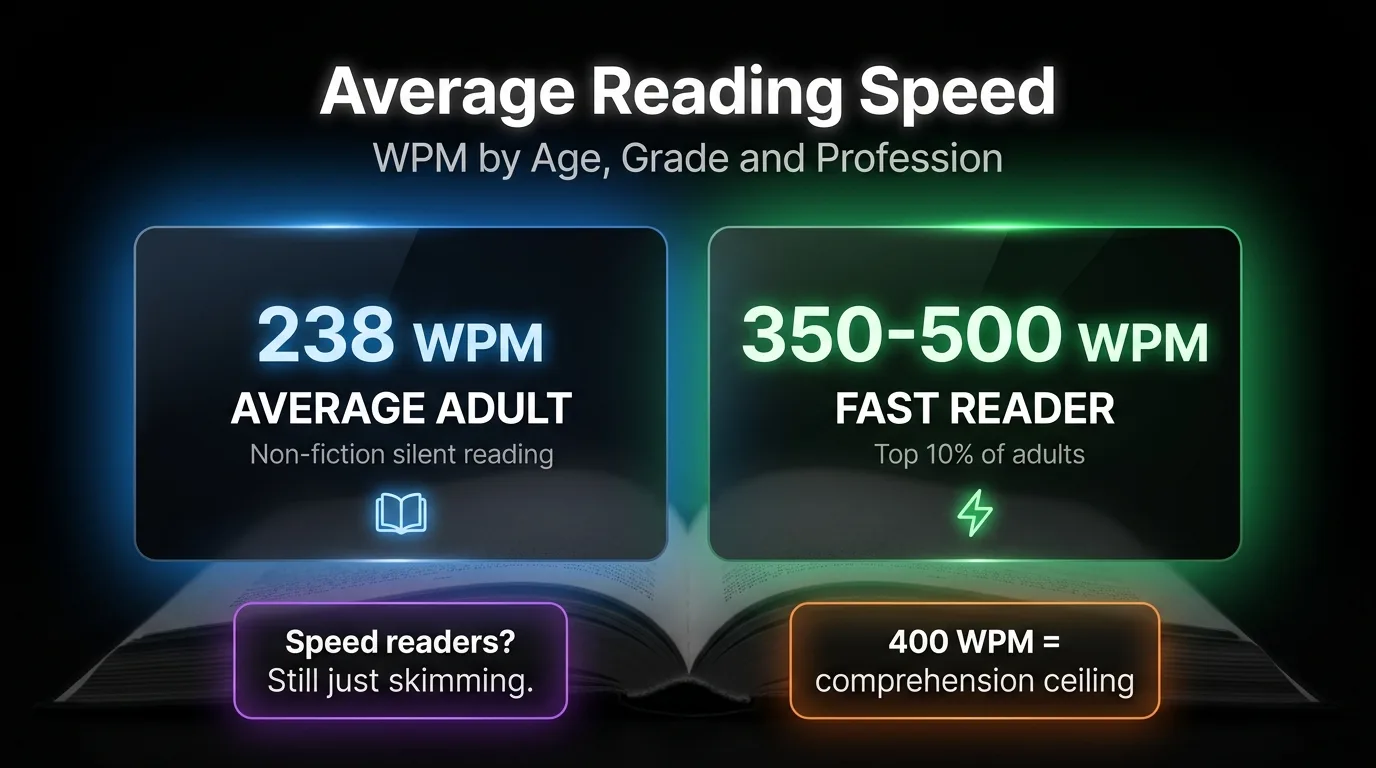
The average adult reads 238 words per minute for non-fiction and 260 WPM for fiction during silent reading. That benchmark comes from Brysbaert's 2019 meta-analysis at Ghent University, which pooled 190 studies and 18,573 participants into the largest reading speed dataset ever compiled. Here is how your speed stacks up by age, grade level, and the kind of material you read.
Average Reading Speed for Adults
Marc Brysbaert, the psychology professor behind that Ghent University dataset, set the modern benchmark: adults average 238 WPM on non-fiction and a slightly quicker 260 WPM on fiction, because stories flow while textbooks make you stop and think. Reading aloud is far slower at 183 WPM, since your voice cannot keep up with your eyes.
Before Brysbaert, the most cited figure belonged to Ronald Carver, whose Rauding Theory placed comfortable adult silent reading at around 300 WPM. Carver was describing college-educated readers cruising through easy material, which is why his number runs higher than the broader population average.
Here is how the full range breaks down:
| WPM Range | Classification |
|---|---|
| Below 150 WPM | Slow |
| 150-200 WPM | Below Average |
| 200-250 WPM | Average |
| 250-350 WPM | Above Average |
| 350-500 WPM | Fast |
| 500+ WPM | Skimming |
Take the free Reading Speed Test to find your exact WPM. And if you spend more time typing than reading, the tiers for a good WPM score at the keyboard work in a surprisingly similar way.
Average Reading Speed by Age and Grade
Reading speed climbs steadily through school, and the climb tracks vocabulary more than anything else. Each grade adds thousands of instantly recognized words, and every word you no longer have to decode is time saved on the page.
| Age / Grade | Average WPM |
|---|---|
| Grade 1 | 53-111 WPM |
| Grade 5 | 139-194 WPM |
| Grade 9 | ~204 WPM |
| Grade 12 | ~250 WPM |
| College Freshman | 280 WPM (Taylor 1965) |
| Average Adult | 238-260 WPM |
| Age 60+ | Gradual decline begins |
Keith Rayner's eye-movement lab at UC San Diego tracked readers for 25 years and found that college-educated adults settle into a 200 to 400 WPM band. The Nelson-Denny Reading Test, the standardized assessment most American colleges use, puts the average student at 250 WPM on test passages, with textbook reading coming in around the same mark.
How Far Does Your Reading Speed Go
Benchmarks feel abstract until you convert them into pages. A standard paperback page holds roughly 250 words, so a reader at 250 WPM turns about one page per minute, or 60 pages an hour. A 300-page novel, somewhere around 75,000 words, takes five to six hours of actual reading time at the average adult pace.
Textbooks are a different story. With around 800 words packed onto each page, that same 250 WPM gets you through only 20 pages an hour. Worth remembering the next time you plan to cover four chapters the night before an exam.
Is Speed Reading Actually Faster
The speed reading industry began with Evelyn Wood, whose Reading Dynamics course hit the market in 1959 promising 2,500 WPM. When researchers measured her students independently, the real gain was 10 to 20%, and comprehension fell while the speed rose.
The record claims get wilder from there. Howard Berg entered the 1990 Guinness World Records at a claimed 25,000 WPM, a figure never verified for actual comprehension. Anne Jones, six-time World Speed Reading Champion, was timed at 4,200 WPM finishing Harry Potter and the Deathly Hallows in 47 minutes. Impressive as performance, but not reading in the sense your brain defines it.
The research verdict has been consistent for decades. Just, Masson and Carpenter tested speed readers running at 600 to 700 WPM back in 1980, and their comprehension scores matched ordinary skimmers. Rayner's 2016 review reached the same conclusion from the eye-movement side: 200 to 400 WPM is the ceiling for full understanding, because beyond that your eyes skip too many words to recover the meaning.
Reading Speed in Special Populations
Averages hide a wide spread. A 2024 statistical analysis of QS Reading Test data put the mean for dyslexic readers at 127.75 WPM, roughly half the general adult figure. The same research found that about 50% of dyslexic students in higher education reach near-average speeds through compensation strategies built up over years of practice.
Reading in a second language slows nearly everyone down. Cop, Drieghe and Duyck (2015) used eye-tracking on bilingual readers and measured them 17% slower in their second language than their first. If English is your L2 and you land below the benchmarks here, that gap is expected, not a weakness.
Wherever you land on these tables, speed is trainable within the comprehension ceiling. Our guide on how to improve reading speed covers the five techniques with real research behind them, starting with one that pays off in about five minutes.
Frequently Asked Questions
What is the average reading speed for adults?
Adults average 238 WPM on non-fiction and 260 WPM on fiction when reading silently. The benchmark comes from a 2019 Ghent University meta-analysis by Marc Brysbaert that pooled 190 studies and 18,573 participants, making it the largest reading speed study ever conducted.
What is a good reading speed?
250 to 350 WPM counts as above average for an adult, and college students typically land between 280 and 350 WPM. Above 350 WPM is fast. Beyond 500 WPM you are usually skimming rather than fully comprehending, according to Keith Rayner's eye-movement research.
How many pages per hour is average?
At the average adult pace of 250 WPM you read about one standard page per minute, which works out to roughly 60 pages per hour for novels. Textbook pages carry around 800 words each, so the same reader manages closer to 20 pages per hour.
Is speed reading real?
Speed reading as marketed is largely a myth. Just, Masson and Carpenter found readers at 600 to 700 WPM scored no better on comprehension tests than skimmers, and Rayner's 2016 review set 200 to 400 WPM as the ceiling for reading with genuine understanding.
Want to know where you rank on these tables? Find your exact WPM in under two minutes.
Free, no signup, results in seconds.
Take the Reading Speed Test