How to Improve Reading Speed: 5 Techniques That Actually Work
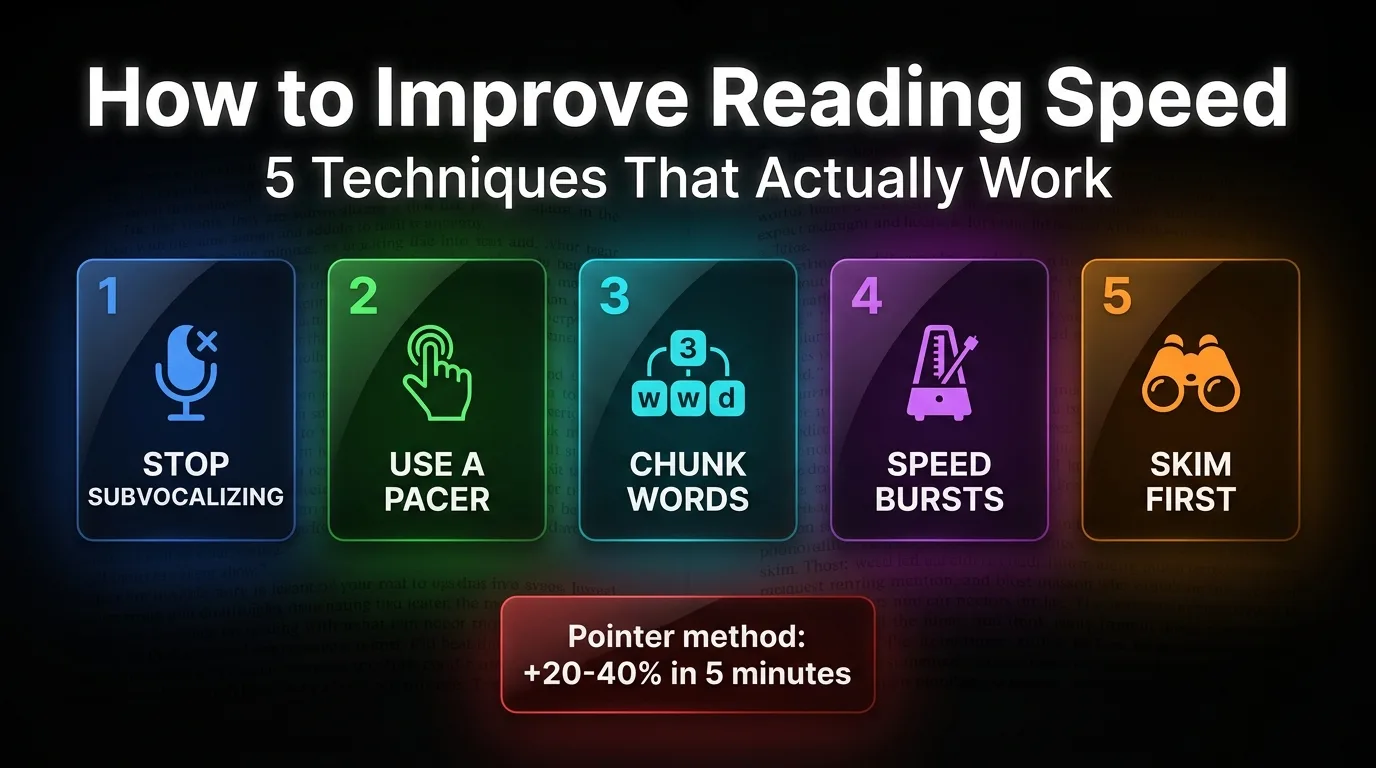
The fastest way to increase your reading speed is the pointer method. Guiding your eyes with a finger cuts down regressions and delivers a 20 to 40% speed boost in under five minutes. But most speed reading advice is junk. Here are the five techniques that hold up in research, what the science says about each one, and the honest ceiling you should actually aim for.
What's Actually Limiting Your Reading Speed
Two habits set your current pace, and you barely notice either one.
The first is subvocalization, the inner voice that pronounces each word as you read. Because that voice runs at roughly your speaking rate, it caps most people at 200 to 300 WPM. You can quiet it down for easy material, but Elizabeth Schotter's research found that silencing it completely wrecks comprehension of complex text. That inner voice is doing real work.
The second is regressions, the small backward jumps your eyes make to re-read a word or line. They feel like wasted time. They are not. Schotter, Tran and Rayner (2014) proved that regressions actively support understanding: when readers were blocked from looking back, comprehension suffered. So the target is cutting unnecessary regressions caused by drifting attention, not eliminating the habit entirely.
For context, the average adult sits around 238 WPM, the baseline Marc Brysbaert established by pooling data from nearly 19,000 tested readers. Every technique below is about climbing from that number without losing the plot.
5 Techniques That Are Research-Backed
1. The Pointer Method
Run a finger, pen, or cursor under each line and keep it moving a touch faster than feels natural. Your eyes follow the pacer instead of wandering back, which kills off back-skipping almost instantly. Reading research credits hand-pacing with a 20 to 40% speed gain after about five minutes of practice. Nothing else on this list pays off faster.
2. Chunking
Stop landing on every single word. Train your eyes to grab 3 to 4 words per glance instead. A practical trick: start each line on the second word and let your peripheral vision catch the first. Fewer fixations per line means less total eye movement, and that saving compounds across a whole page.
3. Reduce Subvocalization (Partially)
Notice the qualifier. The goal is turning the inner voice down, not off. On familiar, easy content you can let your eyes outrun the voice and push past 300 WPM. On dense or technical material, let it run at full volume. The research is clear that complex text needs that inner articulation to be understood.
4. Speed Bursts
Push deliberately past your comfortable pace for 3 to 5 minutes a day, aiming for about one line per second. Comprehension will dip during the burst. That's fine. It is a training set, not real reading. Done daily, bursts recalibrate what comfortable feels like, and your natural pace creeps up behind it.
5. Skim Before Reading
Spend a minute or two scanning headings, bold text, and first sentences before properly reading a chapter. This works because background knowledge, what researchers call schema, drives reading speed more than any eye trick. Brysbaert found topic familiarity matters more than technique alone. Skimming first builds a cheap mental map, so the full read flows noticeably faster.
What Won't Work (And Why People Think It Does)
RSVP apps flash words one at a time in a fixed spot at high speed, and the demo feels like a superpower. The catch is what flashing removes: regressions and parafoveal preview, the sneak peek your eyes take at upcoming words. Both are essential. Studies show literal comprehension is impaired with RSVP. You are not reading faster, you are watching words go by.
Speed reading courses have an even older problem. Evelyn Wood's Reading Dynamics launched in 1959 with claims of 2,500 WPM. Independent testing told a different story: her students gained only 10 to 20%, moving from around 280 to 400 WPM, while their comprehension slid from 81% to 74%. Her company's measurement methods turned out to be distorted. And when Just, Masson and Carpenter put trained speed readers through comprehension tests at 600 to 700 WPM in 1980, they scored no better than people who were told to just skim.
What Speed Should You Actually Aim For
Keith Rayner spent decades recording eye movements at UC San Diego, and Rayner's 2016 review of 25 years of that research landed on a firm number: 200 to 400 WPM is the range where full comprehension survives. Past 400, your eyes physically cannot fixate on enough words to capture detailed meaning. Aim for the top of the honest range, 350 to 400 WPM with comprehension intact, and ignore the 1,000 WPM crowd.
The long game is vocabulary. Rayner concluded that language skill, not eye speed, is the heart of reading speed. Every word you recognize instantly is one less word your brain has to decode, which is why your pace climbs naturally as your vocabulary widens. Curious how those numbers spread across ages and grades? See the full average reading speed breakdown. And the same benchmark thinking applies at the keyboard too: if you type a lot, check what counts as a good WPM benchmark for typing.
Before applying any of these techniques, test your reading speed to get your current baseline, then retest weekly. A 20% gain with comprehension intact beats a 100% gain you cannot remember anything from.
Frequently Asked Questions
What is the fastest way to increase reading speed?
The pointer method, using a finger or pen to guide your eyes across each line, is the fastest technique. Reading research shows it can increase speed by 20 to 40% in under five minutes by preventing eye regressions. It requires no special training and works immediately.
Can you really learn to speed read?
You can read faster, but not at the speeds speed reading courses promise. Keith Rayner's research established roughly 400 WPM as the practical ceiling for full comprehension. Above that you are skimming. Evelyn Wood's students improved only 10 to 20%, and their comprehension dropped while doing it.
Does subvocalization slow you down?
Yes, but eliminating it completely is counterproductive. Subvocalization caps most people at 200 to 300 WPM, and partially reducing it allows faster speeds on easy material. Elizabeth Schotter's research shows the inner voice is essential for understanding complex or unfamiliar text, so suppressing it entirely damages comprehension.
How long does it take to improve reading speed?
The pointer method works in minutes. A sustainable 20 to 40% improvement typically takes 2 to 4 weeks of daily practice. Long-term gains come from vocabulary growth, which takes months but raises your speed without costing any comprehension.
Find your reading speed baseline now, then retest after two weeks of practice to see the gains.
Free, no signup, results in seconds.
Take the Reading Speed Test