CPS Score by Age: How Clicking Speed Changes Over Time
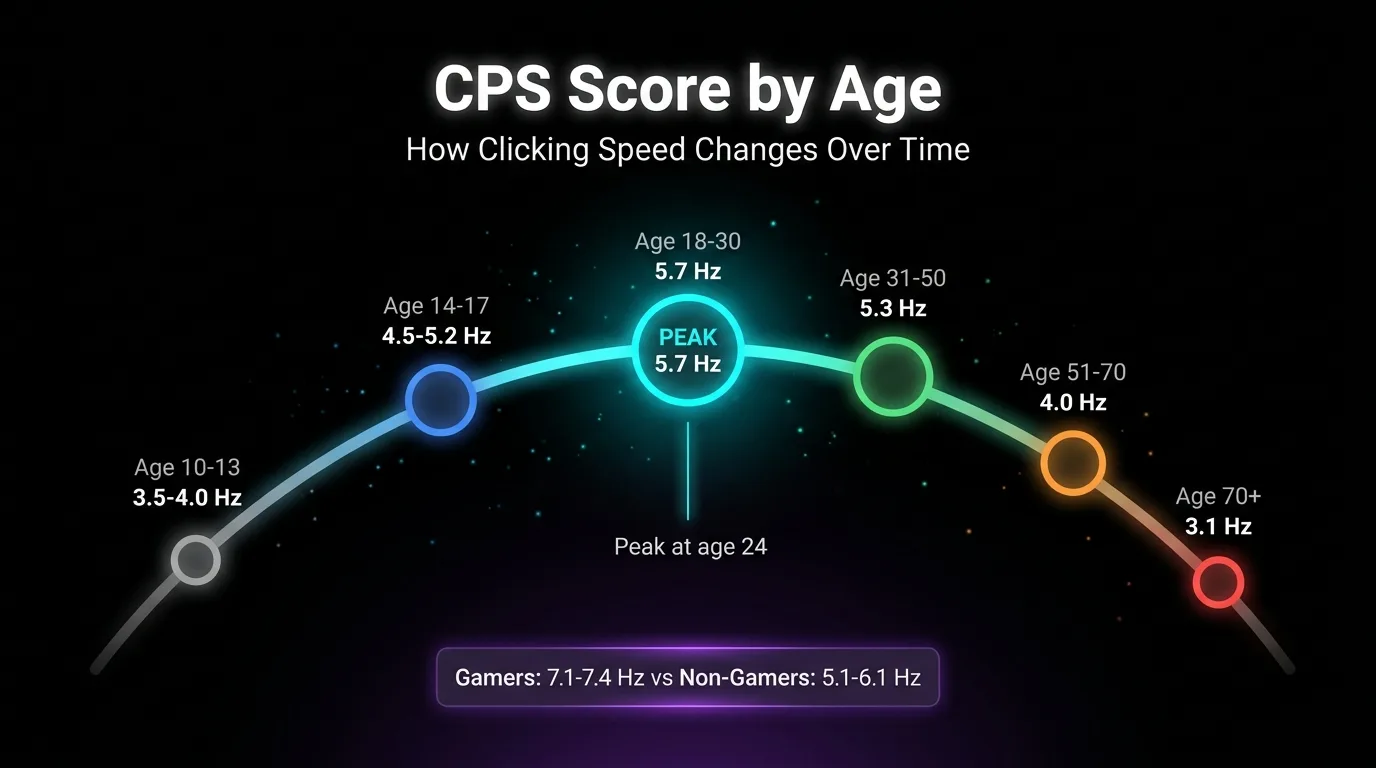
Clicking speed peaks around age 24 and declines gradually from there. Research by Yokoe et al. shows the average adult loses 0.55 Hz of tapping speed per decade. Teenagers aged 14-17 typically hit 4.5-5.2 Hz while elite esports players in their peak years reach 7.1-7.4 Hz. Here is the full breakdown by age group with exact benchmarks from peer-reviewed motor research.
Average CPS Score by Age Group
These benchmarks come from peer-reviewed finger tapping studies across the full human lifespan. Ekşioğlu and İşeri 2015 from Boğaziçi University ran a full lifespan ANOVA model mapping tapping frequency at each age cohort relative to a 20.56 taps per 5 seconds baseline. Their 18-29 cohort outperformed that baseline by 3.79 taps per 5 seconds. Each decade after that steadily eroded the advantage.
| Age Group | Avg Tapping Speed | Approx CPS | Notes |
|---|---|---|---|
| Under 10 | Variable | 2-4 CPS | Motor system still developing |
| 10-13 | 3.5-4.0 Hz | 3-4 CPS | Developmental plateau |
| 14-17 | 4.5-5.2 Hz | 4-5 CPS | Transcallosal inhibition maturing |
| 18-30 | 4.87-5.71 Hz | 5-6 CPS | Peak window |
| 31-50 | 4.5-5.3 Hz | 4-5 CPS | Stable, slight decline |
| 51-70 | 3.7-4.0 Hz | 3-4 CPS | Measurable decline |
| 70+ | 2.36-3.12 Hz | 2-3 CPS | Steepest decline |
The youngest age group data comes from Memisevic et al. 2017, who used the PEBL Finger Tapping Test on preschoolers aged 3-6. Tapping speed improves linearly across those years and gender differences are completely absent before age 6. The variability in the under-10 row reflects that developmental spread, not measurement noise.
The 70+ figures come from two sources. Kwon et al. 2022 used gyrosensor-based measurement on adults aged 70-89 and recorded 2.36 Hz. Ekşioğlu and İşeri's own 70-85 cohort reached 3.12 Hz. The gap between them reflects methodology: gyrosensors capture only intentional movements, while standard tapping tests can include low-amplitude involuntary taps that inflate the count.
Elite esports players in the 18-30 window reach 7.1-7.4 Hz through trained feedforward processing, where the motor cortex pre-programs click sequences instead of reacting to sensory feedback. Non-gamers in the same age range average 5.1-6.1 Hz. Test your current score with the free CPS test on ToolsBracker and see where you fall on the table above.
Why Teenagers Improve So Fast
The speed jump from the 10-13 cohort to the 14-17 cohort reflects a specific neurological event. Transcallosal inhibition finishes developing between ages 10 and 14. Before this point, motor overflow causes involuntary co-movement in adjacent fingers during fast clicking. Your ring finger moves when your index fires. Each unintended signal bleeds speed and precision from the intended movement. Once transcallosal inhibition is established, unilateral movements become cleaner and the click rate jumps accordingly.
Motor myelination continues through the twenties as well. Teenagers are still laying down the neural insulation that determines signal conduction speed. This is why a 16-year-old with six months of focused practice can genuinely close the gap on a 25-year-old with years of experience. Their nervous system is still physically getting faster.
If you are aged 12-17, the training priority is precision and rhythm, not raw speed. Jitter clicking is off the table at this stage. Developing musculoskeletal systems are not ready for the sustained co-contraction demands jitter technique places on the forearm and the overuse risk is real in growing tendons. Build clean mechanics first. The speed ceiling rises by itself as your nervous system matures.
When Does CPS Peak and Why It Declines
Clicking speed peaks around age 24. That is when cognitive processing speed, which governs how fast the motor cortex fires and corrects movement sequences, reaches its measured high point in the COBRA longitudinal study before beginning its gradual downward trend.
Yokoe et al. 2015 quantified the loss rate: 0.55 Hz per decade in the dominant hand. The number sounds small in isolation. In practice it means a 5.5 Hz player at 25 is statistically likely to test at 4.95 Hz by 35 and at 4.4 Hz by 45. Not a cliff. A slow, continuous ramp downward.
The mechanism is dopaminergic, not muscular. The COBRA longitudinal study found striatal dopamine D2-receptor availability drops 5% per decade. The striatum coordinates motor timing, so as D2 availability falls, the precision of the timing signals your motor cortex sends degrades with it. Muscles and tendons stay intact. The system that times when to fire them is what ages.
Decline becomes statistically measurable in the fifth decade, ages 40-49, and accelerates after 50. Heimhofer et al. 2024 confirmed this acceleration pattern in a large-scale motor assessment. The 50-59 cohort in Ekşioğlu and İşeri's data landed at 3.98 Hz, the 60-69 cohort dropped to 3.71 Hz, and the 70-85 cohort came in at 3.12 Hz.
On gender: Memisevic et al. found zero difference under age 6. After puberty, males consistently test faster due to a higher proportion of fast-twitch Type II muscle fibers in the forearm. Ruff and Parker 1993 found that female decline accelerates after 55, tied to post-menopausal endocrine changes affecting neuromuscular transmission. The dominant hand stays 10-15% faster than the non-dominant across all adult cohorts regardless of gender. To put your score in context against skill levels rather than just age, see what counts as a good CPS score.
What This Means for Gamers at Every Age
Peak competitive age varies by genre. Fortnite and Battle Royale favor the 14-24 window, where reaction speed and motor ceiling are both high. FPS titles like Valorant and CS2 peak at 18-26, where top motor speed meets early tactical experience. MOBAs peak later at 18-28 because game knowledge compensates longer for any physical decline.
| Game Type | Peak Age Window |
|---|---|
| Fortnite / Battle Royale | 14-24 |
| FPS (Valorant, CS2) | 18-26 |
| MOBA (League, Dota) | 18-28 |
If you are in the 18-30 window, you are at peak ceiling and peak neuroplasticity at the same time. High-intensity deliberate practice yields the highest absolute gains here. After 30, the physical ceiling lowers slowly, but targeted training can still improve speed by 10-27% through neural efficiency gains. Game sense and anticipation cover the rest at most competitive levels.
These benchmarks connect to something larger than gaming. Myong et al. 2025 measured healthy adults at 9.96 CPS average in a clinical 20-second smartphone tap test. Parkinson's patients in the same protocol averaged 3.81 CPS. Suzumura et al. 2022 used tapping decline as an MCI screening tool, recording significant reductions in tap counts at p=0.005 and prolonged tapping intervals at p=0.007 in patients with mild cognitive impairment. Finger tapping speed is a real clinical diagnostic window into central nervous system health, which is why the research behind this table comes from motor labs rather than gaming surveys. For a training plan built around your age window, see how to increase your CPS. For context on what the absolute ceiling looks like, see the highest CPS ever recorded.
Frequently Asked Questions
What is the average CPS for a 14-year-old?
Research shows teenagers aged 14-17 typically achieve 4.5-5.2 Hz in finger tapping tests, which translates to roughly 4-5 CPS on a standard click test. With gaming practice, scores in this age group often reach 6-8 CPS as transcallosal inhibition finishes maturing and motor pathways become more efficient.
At what age is CPS highest?
Clicking speed peaks around age 24 based on motor research and cognitive processing speed data. The 18-30 window is the absolute peak range. Ekşioğlu and İşeri 2015 from Boğaziçi University documented this as the highest cohort in their full lifespan tapping model.
Does CPS decline with age?
Yes. Yokoe et al. 2015 established that the average adult loses approximately 0.55 Hz of tapping speed per decade. Decline becomes statistically measurable in the 40s and accelerates after 50. The primary cause is dopaminergic degradation in the striatum, not muscle aging.
Can older adults improve their CPS?
Yes. Research shows targeted reaction and clicking training can improve speed in adults over 30 by 10-27% through increased neural efficiency. The absolute ceiling is lower than at 20, but meaningful improvement is achievable with structured practice.
Why are teenagers sometimes faster than adults?
Teenagers aged 14-17 are finishing the maturation of transcallosal inhibition, the mechanism that prevents involuntary finger co-movement during fast clicking. Combined with high neuroplasticity, this means teens respond to CPS training faster than adults and can close the gap on older players with consistent practice.
Curious where your CPS falls on the age curve? Take the free CPS Test on ToolsBracker. No signup, instant results, see exactly how you compare.
Free, no signup, results in seconds.
Take the CPS Test