Hearing Frequency by Age: What Hz Can You Hear at Each Decade?
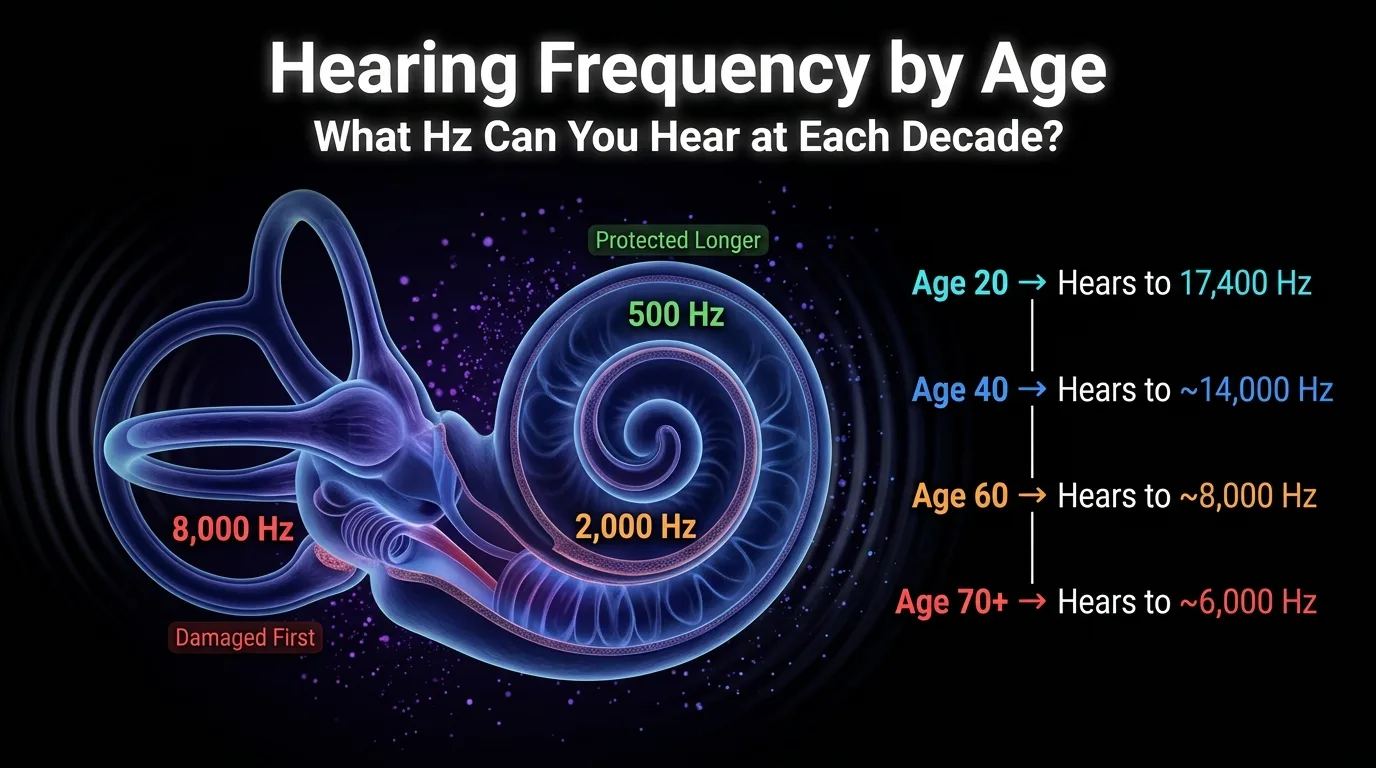
Your ability to hear high-frequency sounds declines gradually from as early as age 18. A healthy young adult can detect up to 20,000 Hz but that upper limit often drops to around 8,000 Hz by age 60. High frequencies go first because of how the cochlea is physically structured. Here is what changes at each decade and why it happens.
Hearing Frequency Range by Age: The Chart
The table below maps approximate upper hearing frequency limits across age groups. These are averages drawn from population studies, not fixed cutoffs. Your actual limit depends on noise exposure history, genetics, and overall health.
| Age Group | Typical Upper Frequency | Stage |
|---|---|---|
| Under 20 | Up to 20,000 Hz | Peak hearing |
| 20-30 | Up to 17,400 Hz | Subtle decline begins |
| 30-40 | Up to ~15,000 Hz | Clinical presbycusis starts |
| 40-50 | Up to ~12,000 Hz | High-freq loss established |
| 50-60 | Up to ~10,000 Hz | Significant high-freq loss |
| 60-70 | Up to ~8,000 Hz | 1 in 3 affected |
| 70+ | Up to ~6,000 Hz | Nearly half affected |
These ranges have significant individual variation. Someone who spent years around loud machinery may track two decades ahead of their age group, while a lifelong ear-protector may still hear 15,000 Hz at 50.
The 17,400 Hz mosquito tone sits right at the boundary for people in their mid-20s. If you can still hear it clearly, your high-frequency hearing is in good shape. For more on how that tone became a teenage phenomenon, read the hearing age test guide.
Why High Frequencies Go First: The Science
The cochlea, the spiral structure in your inner ear, does not process all frequencies equally. It uses a system called tonotopic organization where different frequencies are mapped to different physical locations along the spiral. Think of it as a frequency keyboard built into a snail shell.
The basal end sits closest to the middle ear. It is the stiffest part and is tuned to high frequencies in the 6,000-8,000 Hz range. The apical end sits at the tight center of the spiral, more flexible, handling low frequencies. Every time you hear anything, sound waves travel the full length of the cochlea from the entrance at the base. That means the outer hair cells at the basal end experience sound energy first, every single time.
Over decades, that repeated stress accumulates. Research by Dr. D.O. Kim at the University of Connecticut Health Center on peripheral auditory system mechanics, alongside cochlear active process studies by Neely and Kim (2008), confirmed that the outer hair cells at the base lose their sharp tuning sensitivity earliest. The cochlear membrane also stiffens with age, becoming progressively less responsive to the tiny vibrations that high-frequency sounds require to be detected.
The result is presbycusis, the permanent age-related sensorineural hearing loss that audiologists find in nearly everyone past age 60. The NIDCD supports ongoing research into the genetic and mechanical causes of this gradual decline.
What Sounds Disappear First as You Age
High-frequency hearing loss follows a predictable pattern in daily life. The sounds that go first are often the ones people miss most before they realize anything has changed.
Bird songs are among the earliest casualties. Species like the Cedar Waxwing, Brown Creeper, and Le Conte's Sparrow sing between 6,000 and 11,000 Hz. People with early high-frequency loss often notice these birds have gone silent long before they notice any difficulty in conversation. The Golden-crowned Kinglet, which sings between 3,000 and 10,000 Hz, begins to sound distorted rather than disappear entirely.
Music changes too. High-frequency overtones give instruments their distinctive timbre and brilliance. When those overtones drop out, music begins to sound flat or amorphous, losing the detail that makes it emotionally engaging. Listeners often attribute this to their speakers or streaming quality without realizing the change is in their own hearing.
The most functionally significant loss involves speech consonants. The sounds p, t, k, f, s, th, sh, and ch are all produced between 4,000 and 6,000 Hz. When these frequencies become harder to detect, speech begins to sound like mumbling. This is exactly why many adults over 50 find TV dialogue increasingly difficult to follow, particularly when background music is playing. The vowels come through clearly. The consonants that distinguish one word from another do not.
Age-Related vs Noise-Induced Frequency Loss
Not all hearing loss follows the same pattern, and knowing the difference helps you understand what your own results mean.
Age-related presbycusis starts at the very highest frequencies and works progressively downward over decades. The frequency chart above reflects this pattern. Noise-induced hearing loss creates a specific dip at exactly 4,000 Hz called the 4kHz notch, the clinical signature of too much loud sound exposure. This notch can appear on an audiogram before you notice any difficulty in daily conversation.
Many adults over 50 have mixed hearing loss combining both patterns. The age-related baseline plus accumulated noise exposure from concerts, headphones, and occupational environments accelerates the total loss faster than either cause alone would. Sounds above 90 dB SPL cause direct damage to outer hair cells, which is why protecting hearing before damage occurs matters more than any treatment afterward.
For the clinical dB thresholds used to measure these losses and how to read a full audiogram, the normal hearing range by age guide covers the complete picture. To check where your own high-frequency hearing stands right now, take the free hearing age test on ToolsBracker.
Frequently Asked Questions
What hearing frequency can humans hear by age?
A healthy person under 20 can typically hear up to 20,000 Hz. By age 30 this often drops to around 15,000 Hz, by age 50 to around 10,000 Hz, and by age 70 to around 6,000 Hz. These are approximate ranges with significant individual variation based on noise exposure and genetics.
Why do high frequencies decline first?
The cochlea uses tonotopic organization where high frequencies are processed at the basal end, the stiffest part nearest the middle ear. These hair cells experience the most cumulative stress and are the most vulnerable to age-related stiffening. Low frequencies processed at the flexible apical end are naturally more protected.
At what age does hearing frequency start to decline?
The first measurable decline in ultra-high frequencies can begin as early as age 18. Most people do not notice anything until their 30s or 40s when loss reaches frequencies relevant to daily speech and environmental sounds.
What sounds disappear first with age-related hearing loss?
High-pitched bird songs are often the first to go, particularly species like the Cedar Waxwing and Brown Creeper which sing between 6,000 and 11,000 Hz. Speech consonants like s, f, th, and sh at 4,000-6,000 Hz are also early losses and explain why speech begins to sound like mumbling.
What is the difference between age-related and noise-induced hearing loss?
Age-related loss (presbycusis) starts at the highest frequencies and works progressively downward. Noise-induced loss creates a specific dip at 4,000 Hz called the 4kHz notch. Many adults experience mixed hearing loss combining both patterns from decades of accumulated noise exposure alongside natural aging.
Can I test my hearing frequency range online?
Yes. Online hearing tests like ToolsBracker's free hearing age test play tones at different frequencies to estimate your hearing age. For the most accurate results use earbuds in a quiet room. Online tests are good for initial screening but cannot replace a clinical audiogram from an audiologist.
Curious where your high-frequency hearing stands? Take the free Hearing Age Test on ToolsBracker. Use earbuds in a quiet room for the most accurate result. No signup, instant results.
Free, no signup, results in seconds.
Take the Hearing Age Test