Normal Hearing Range by Age: Hz and dB Benchmarks Explained
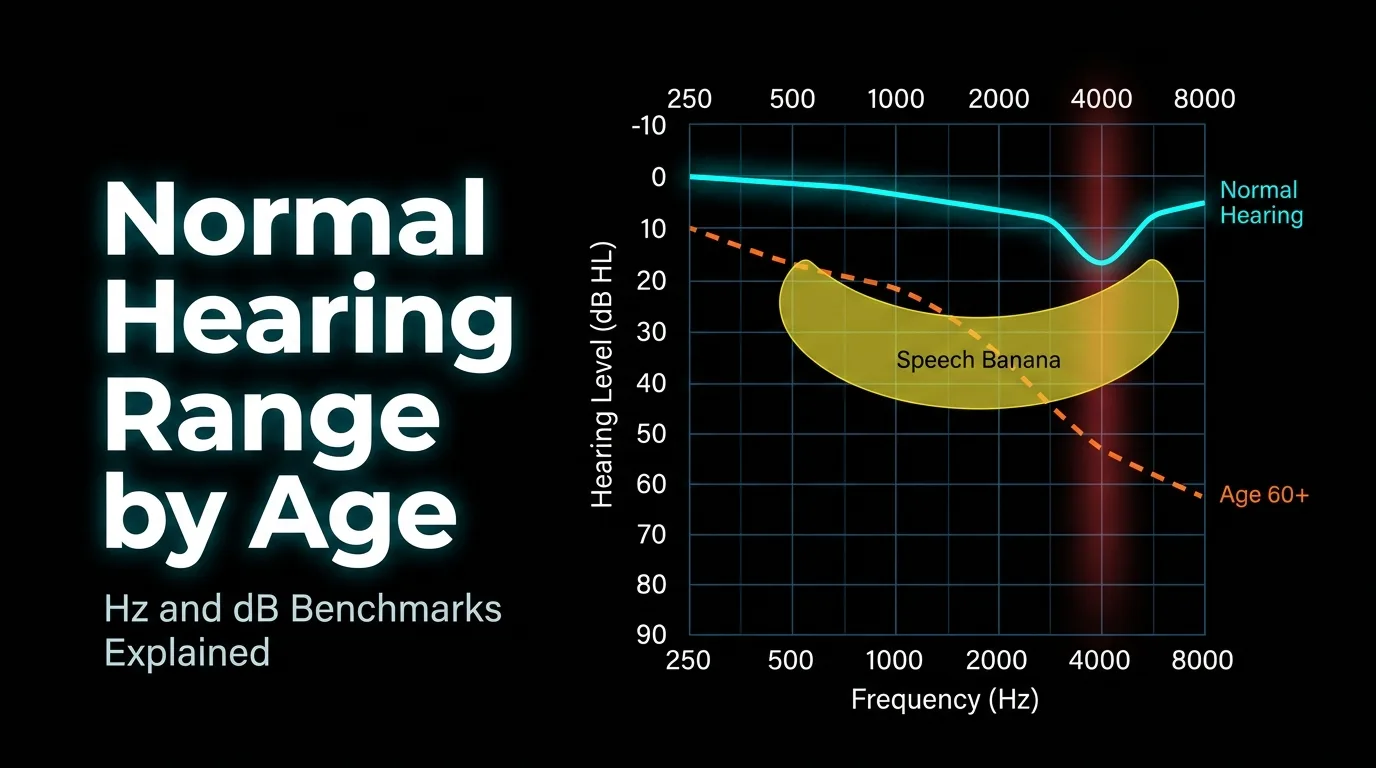
Normal hearing range for a healthy young adult spans 20 Hz to 20,000 Hz in frequency and sits between -10 and 25 dB HL in loudness. Both numbers matter when reading a hearing test result. Frequency (Hz) tells you which pitches you can detect. Decibels (dB) tell you how loud a sound needs to be before you can hear it. Here is what normal looks like across different ages.
What Is Normal Hearing Range in Hz?
Hertz measures frequency, the pitch of a sound. Decibels measure loudness, how much volume is needed before you can detect it. A hearing test gives you results in both, and you need both to understand what your score actually means.
A healthy young person hears from 20 Hz to 20,000 Hz. Audiologists focus on 250 Hz to 8,000 Hz for clinical testing because this range covers the full spectrum of human speech. Most everyday speech sounds fall between 500 Hz and 4,000 Hz. Lose hearing in this band and conversations become difficult even if your low-frequency hearing stays intact.
High-frequency decline typically begins in adolescence. The highest frequencies go first, above 8,000 Hz, then gradually work downward over decades. Most people notice nothing until their 30s or 40s, well after the process has started. For a full breakdown of how frequency loss progresses by age group, the hearing age test guide covers the complete picture alongside typical Hz ranges at each decade.
Normal Hearing Range in Decibels (dB HL)
The dB HL scale measures hearing level. A lower number means you can detect softer sounds. A higher number means sounds need to be louder before you register them.
| Hearing Level | dB HL Range | What It Means |
|---|---|---|
| Normal | -10 to 15 dB HL | No difficulty with everyday sounds |
| Slight | 16 to 25 dB HL | Soft speech may be missed |
| Mild loss | 26 to 40 dB HL | Quiet conversations become difficult |
| Moderate loss | 41 to 55 dB HL | Normal speech often missed |
| Moderately severe | 56 to 70 dB HL | Loud speech needed to follow along |
| Severe loss | 71 to 90 dB HL | Shouting is barely audible |
| Profound loss | 91+ dB HL | Near total hearing loss |
These classifications come from the American Speech-Language-Hearing Association, which provides the clinical framework audiologists use worldwide. Adults are screened at 25 dB HL. Children are held to 20 dB HL, a stricter standard because even a slight threshold shift can affect language development at early ages.
The World Health Organization defines disabling hearing loss as greater than 35 dB in the better-hearing ear. By that standard, over 25% of adults over 60 qualify, and 55% of those aged 75 and older. Men between 20 and 69 are nearly twice as likely as women to have clinically significant hearing loss. As of 2-3 out of every 1,000 children are born with detectable hearing loss, so these numbers start earlier than most people assume.
Everyday Sound Levels: The 85 dB Threshold
Putting dB numbers in context helps you understand where the real stakes are. The table below maps familiar sounds to their approximate decibel levels.
| Sound | Approximate dB |
|---|---|
| Whisper | 30 dB |
| Normal conversation | 60 dB |
| Busy restaurant | 70 dB |
| Lawnmower | 85 dB |
| Concert or nightclub | 100 to 110 dB |
| Jet engine nearby | 140 dB |
85 dB is the damage threshold. Sounds at or above this level cause permanent hair cell loss with prolonged exposure. A concert hits 100 to 110 dB, well past the danger zone in under two hours without ear protection.
How to Read a Normal Audiogram
An audiogram is a graph showing your hearing sensitivity across frequencies and loudness levels. It looks technical at first glance but follows a simple logic once you know what each axis represents.
The horizontal axis shows frequency in Hz, with low pitches on the left and high pitches on the right. The vertical axis shows hearing level in dB HL, with quiet sounds at the top and loud sounds at the bottom. A normal audiogram shows marks clustered near the top of the graph between -10 and 20 dB HL. If your marks appear lower on the page, sounds need to be louder before you detect them.
The Pure Tone Average, or PTA, is the arithmetic mean of your thresholds at 500, 1,000, and 2,000 Hz. Audiologists use it as a quick summary of speech-frequency hearing ability. Work by James F. Jerger PhD, founder of the American Academy of Audiology and a leading figure in auditory aging research at Baylor College of Medicine, established much of the interpretive framework behind modern diagnostic audiometry. A PTA of 25 dB HL or better is considered normal for adults.
A typical ski-slope pattern shows normal hearing at low frequencies with a sharp drop at high frequencies. This is the most common audiogram shape for people over 50. It reflects presbycusis progressing from the top of the frequency range downward, exactly as the normal hearing frequency range contracts with age.
The Speech Banana: Why These Frequencies Matter Most
On an audiogram, all the sounds of human speech cluster into one specific zone called the speech banana. The name comes from its distinctive banana shape when plotted on the chart.
The speech banana covers 250 Hz to 8,000 Hz at intensities between 20 and 50 dB HL. Every phoneme in a normal conversation falls somewhere inside this zone. Vowels sit at the lower-frequency end, from 250 Hz to 2,000 Hz, and they are naturally louder. Consonants like s, th, and f sit at the higher-frequency end, from 2,000 Hz to 8,000 Hz, and they are softer but carry most of the information needed to distinguish one word from another.
This is why people with early high-frequency loss often say "I can hear you talking but I cannot make out what you are saying." Their vowel hearing is still intact. The consonant frequencies are lost. Any hearing loss that pushes thresholds outside the speech banana creates this exact disconnect, and it is one of the clearest signs that a clinical audiogram is worth scheduling.
Normal hearing audiogram marks sit inside or above the speech banana. When a threshold mark dips below the banana on the graph, that frequency range has crossed from normal into clinically notable territory.
The 4kHz Notch: What Headphone Users Should Know
One pattern audiologists watch for is a specific dip in hearing sensitivity at exactly 4,000 Hz called the 4kHz notch. It is the clinical fingerprint of noise-induced hearing loss.
The hair cells in your inner ear that respond to 4,000 Hz are uniquely vulnerable. The outer and middle ear transmit sound energy near this frequency with particular efficiency, which means these cells receive the full force of loud sounds before any other part of the cochlea. Research by Sadhra et al. and Le Prell et al. has documented this notch in studies of industrial workers and regular headphone users alike.
The notch can appear on an audiogram before you notice any difficulty in daily conversation. If you listen to music at high volume regularly, your 4kHz threshold may already be dropping without any obvious symptoms. The NIDCD hearing statistics page shows how common noise-induced hearing loss has become among younger adults, a group audiologists now treat far more frequently than in previous decades.
If you want to pair hearing with another sensory check, the color blind test takes under a minute with no signup. To see where your own high-frequency hearing currently stands, take the free hearing age test on ToolsBracker. Earbuds in a quiet room give the most reliable result.
Frequently Asked Questions
What is normal hearing range by age in Hz?
A healthy young adult can hear from 20 Hz to 20,000 Hz. Audiologists focus on 250 Hz to 8,000 Hz for clinical testing because this range covers all speech frequencies. High-frequency decline begins in adolescence and progresses gradually, with the 2,000-8,000 Hz range most critical for speech clarity.
What is normal hearing in decibels (dB)?
Normal hearing is defined as thresholds between -10 and 25 dB HL according to the American Speech-Language-Hearing Association. Children are held to a stricter standard of 20 dB HL because even slight losses affect language development. The WHO defines disabling hearing loss as greater than 35 dB in the better-hearing ear.
What is the speech banana on an audiogram?
The speech banana is a banana-shaped zone on an audiogram covering 250 Hz to 8,000 Hz at 20 to 50 dB HL. All sounds of human speech fall within this area. Hearing loss that pushes your thresholds outside the speech banana causes difficulty understanding words even when you can clearly hear voices.
What is the 4kHz notch?
The 4kHz notch is a characteristic dip in hearing sensitivity at 4,000 Hz that indicates noise-induced hearing loss. The inner ear hair cells at this frequency are uniquely vulnerable to sound damage. It is commonly found in people with long-term exposure to loud music, industrial noise, or headphone use.
What is Pure Tone Average (PTA)?
Pure Tone Average is the arithmetic mean of hearing thresholds at 500, 1,000, and 2,000 Hz. Audiologists use it as a quick summary of speech-frequency hearing ability. A PTA of 25 dB HL or better is considered normal for adults.
How does normal hearing range change with age?
High-frequency hearing typically begins declining in adolescence, though most people notice nothing until their 40s or 50s. Over 25% of adults over 60 have disabling hearing loss. Men are nearly twice as likely as women to have hearing loss between ages 20 and 69. The condition is called presbycusis and it cannot currently be prevented, though noise-induced hearing loss can be.
Want to check your own hearing range? Take the free Hearing Age Test on ToolsBracker. Works best with earbuds in a quiet room. No signup, instant results.
Free, no signup, results in seconds.
Take the Hearing Age Test