How Long Should You Aim Train Per Day? The Science-Backed Answer
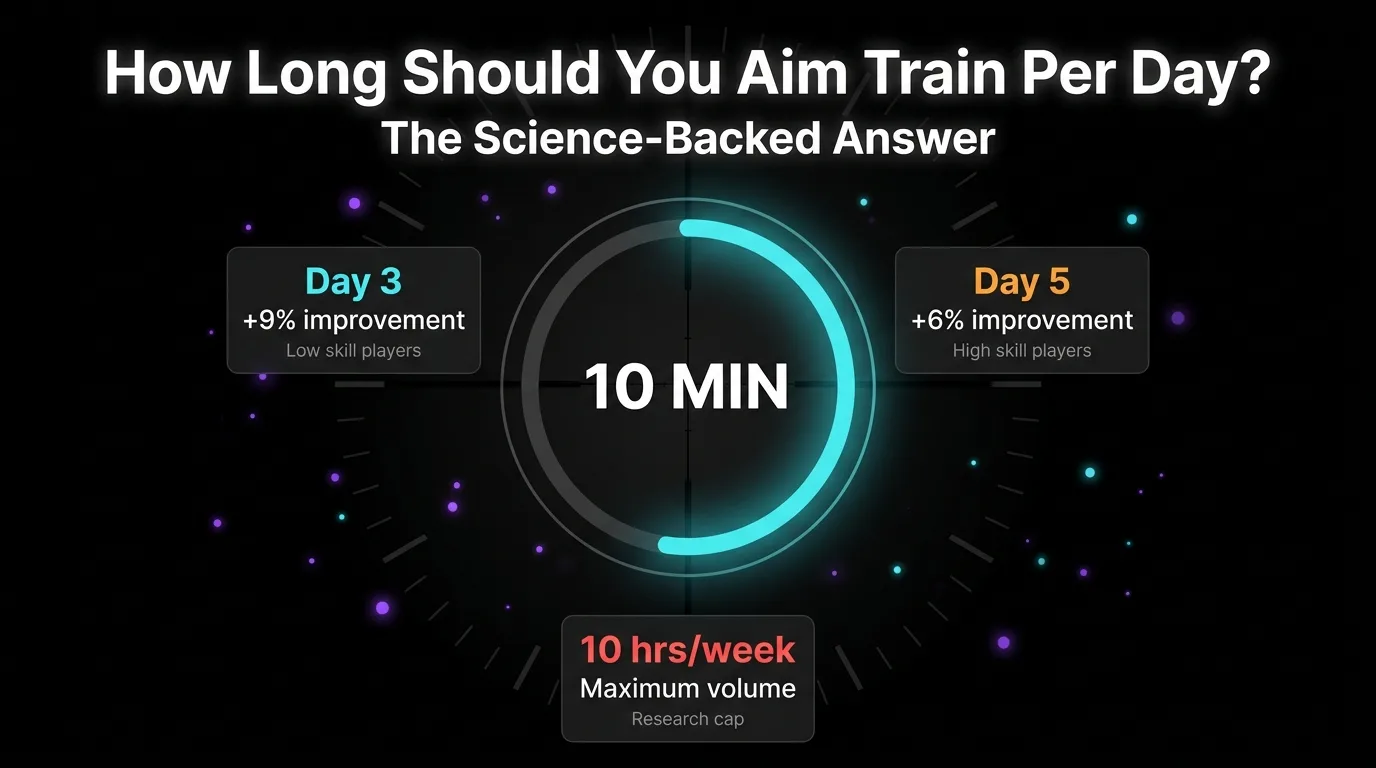
Research says 10 minutes of deliberate aim training per day is enough to produce measurable improvement within 3 to 5 days. A 2021 study by Toth et al. demonstrated this with a focused flicking protocol in CS:GO. But the structure of those 10 minutes matters more than most players realize. Here is exactly how to build an effective daily routine.
How Long Should You Aim Train: The Research Answer
Ten minutes per day. That is the research-backed minimum that produces real results.
Toth et al. 2021 ran a 5-day protocol using 10-minute daily sessions focused on flicking, a core FPS mechanical skill. After just 5 days the numbers were clear.
| Skill Level | Improvement in 5 Days |
|---|---|
| Low-skill players | ~9% performance gain |
| High-skill players | 6.09% performance gain |
| All players combined | Significant across all levels |
Two things stand out from that data. Lower-skill players gain more from the same training time. If you are new to aim training you will see faster visible improvement because you have more room to grow. But high-skill players still improved by over 6% in 5 days of 10-minute sessions. The improvement never fully stops, it just slows with expertise.
Aim and raw reaction speed compound each other during training. Your average reaction time by age is a useful baseline to establish before you start so you can track what is actually improving over time.
Warm-Up vs Skill Building: How to Split Your Time
A 2024 study by Rogers et al. found that just 5 attempts at two specific shooting tasks, approximately 10 minutes total, was sufficient to stabilize player performance before competition. That finding gives us a practical framework for structuring a daily session.
For a 10-minute daily session:
- First 3 to 4 minutes: warm-up on familiar, easy scenarios. The goal is not improvement, it is activation. Getting your motor pathways firing before you demand precise input.
- Remaining 6 to 7 minutes: deliberate practice on scenarios that challenge you. Targets slightly faster than comfortable. Distances slightly further than your usual range. This is where real improvement happens.
ToolsBracker's free aim trainer works well for both phases without needing an account or download. Run a familiar scenario for your warm-up block, then switch to a harder target speed for deliberate practice.
Deliberate Practice vs Just Playing Matches
Many players believe that playing ranked matches IS their aim training. It is not.
Research on expertise development consistently shows that deliberate practice on specific component skills, like isolated flicking or tracking drills, produces faster improvement than accumulating game hours. Dr. Seth Jenny at Slippery Rock University, who advises KovaaK's professional aim training software, describes deliberate practice as choosing effortful, specific component activities over passive experience accumulation.
The practical difference:
- Playing ranked: you practice everything at once, including decision making, game sense, economy, and positioning. Aim improves slowly as a side effect of general play.
- Aim trainer sessions: you isolate the mechanical skill and stress it directly. Improvement is faster and more measurable because nothing else is competing for your attention.
Both matter for becoming a complete player. But 10 minutes of isolated aim training adds more to your mechanical skill ceiling than an hour of ranked play adds on its own. Aim also compounds with reaction speed. The how to improve reaction time guide covers the complementary skills that make aim training more effective over time.
Weekly Structure and When to Increase Volume
Research caps effective training at 10 hours per week maximum before diminishing returns and fatigue become counterproductive. For most players, 10 to 15 minutes daily sits well within that ceiling and produces consistent results without burnout.
A simple weekly structure that works:
- Monday to Friday: 10 to 15 minute daily sessions split between warm-up and deliberate practice.
- Saturday: optional longer session of 20 to 30 minutes focused on the specific scenarios that challenged you most during the week.
- Sunday: rest. Sleep consolidates the motor memories built across the week. Skipping rest days costs you progress even if it feels like training more.
Signs you should increase your session length: familiar scenarios feel consistently easy, your accuracy on standard drills stays above 80%, or you feel under-stimulated during training.
Signs you may be overtraining: performance gets worse session to session despite consistent practice, you feel frustrated and tense during training, or your accuracy drops noticeably below your usual baseline. At that point rest is the most productive thing you can do.
For the full science on why aim training works at a neurological level, read the does aim training work guide.
Frequently Asked Questions
How long should you aim train per day?
Research by Toth et al. 2021 shows 10 minutes of deliberate daily practice produces measurable improvement within 3 to 5 days. Most players see the best results from 10 to 15 minute daily sessions rather than longer occasional sessions. Consistency matters more than volume.
Is 10 minutes of aim training enough?
Yes, for most players. The Toth et al. 2021 study demonstrated significant improvement from just 10 minutes per day, with low-skill players improving by around 9% and high-skill players by 6.09% over 5 days. Short focused sessions outperform long unfocused ones.
How many days a week should you aim train?
Daily training produces the best results based on research. If that is not possible, 5 days per week with rest days allows for sleep-based motor memory consolidation. Research caps effective volume at 10 hours per week maximum before fatigue becomes counterproductive.
What is the difference between warm-up and deliberate practice in aim training?
Warm-up uses familiar easy scenarios to activate motor pathways before demanding precise input, typically 3 to 4 minutes. Deliberate practice uses challenging scenarios slightly above your comfort level where real improvement happens. A Rogers et al. 2024 study found 10 minutes total was sufficient to stabilize performance before competition.
Should you aim train before or after playing ranked?
Before is generally better. Use aim training as a warm-up before ranked sessions to activate your motor pathways. Aim training after ranked sessions when you are already fatigued produces less improvement and can reinforce habits formed during tired play.
How do you know when to increase your aim training time?
Increase session length when familiar scenarios consistently feel too easy, your accuracy on standard drills stays above 80%, or you feel under-stimulated. If your performance drops session to session despite regular practice, you may be overtraining and need more rest between sessions.
Start your 10-minute daily routine today. Try the free Aim Trainer on ToolsBracker. No download, no signup, works in any browser. Test your baseline accuracy before you start training so you can track your improvement.
Free, no signup, results in seconds.
Take the Aim Trainer