Is 52 WPM Good? Honest Answers for Every WPM Score
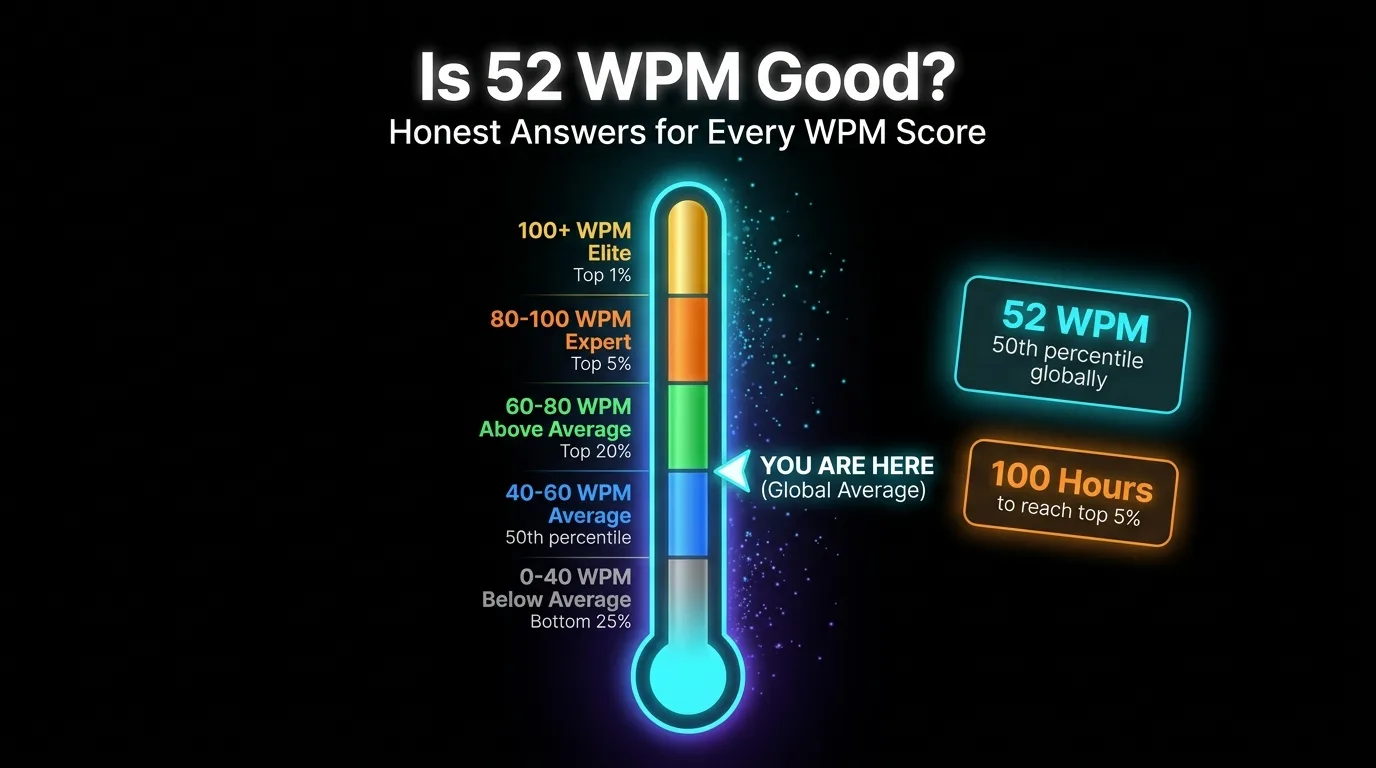
Yes, 52 WPM is good. It is exactly the global average according to Dhakal et al. 2018 at Aalto University, who analyzed 136 million keystrokes from 168,000 volunteers. That puts you at the 50th percentile of all typists worldwide. Whether that is good enough depends entirely on what you need it for. Here is what every WPM score actually means.
What Your WPM Score Actually Means
Most people judge their WPM score against a vague sense of "fast" or "slow." The percentiles give you something more honest. The numbers below come from the global average typing speed research, cross-referenced with TypeRacer and TypeLit.io data covering hundreds of thousands of test sessions.
| WPM | Percentile (General) | Rating |
|---|---|---|
| Under 30 | Bottom 10% | Below handwriting speed |
| 30-40 | 10-25th | Beginner |
| 40-50 | 25-50th | Average |
| 52 | 50th | Global average |
| 60 | ~80th | Above average |
| 70 | ~90th | Advanced |
| 80 | ~95th | Expert |
| 100+ | 99th | Elite |
One platform caveat: these percentiles reflect the general population. On TypeRacer, where enthusiasts practice daily, 60 WPM is only the 25th percentile because the platform self-selects fast typists. The same score can look very different depending on which leaderboard you are standing next to.
One figure that surprises most people: 30 WPM is slower than average handwriting speed, which sits at 31 WPM. If you are typing at that pace, the keyboard is not saving you any time over pen and paper.
Also worth knowing: your test score is likely 5-15 WPM higher than your real writing speed. Vanderbilt University research found copy-typing familiar words is consistently faster than composing original text, because you are not generating ideas at the same time. A test score is your mechanical ceiling, not your everyday output.
Is Your WPM Good Enough for Your Goal
The right WPM depends on the work. A programmer who needs precision over velocity has different requirements than a medical transcriptionist racing a doctor's dictation. Here is what counts as a good WPM across specific roles:
| Role | WPM Needed | Notes |
|---|---|---|
| Basic office work | 40 WPM | US OPM federal minimum |
| Customer service chat | 35-55 WPM | Composing while reading |
| Programmer | 40-60 WPM | Precision over speed |
| Student | 54-80 WPM | Higher means better notes |
| Data entry | 70-80 WPM | Volume dependent |
| Writer / blogger | 70-90 WPM | Deadline driven |
| Medical transcription | 65-100 WPM | Accuracy critical |
The medical side of this data is striking. Kalava et al. 2014 found that medical residents average only 30.4 net WPM, slower than a high-school student. That gap creates real bottlenecks in electronic health records systems, where documentation time cuts directly into patient care hours.
On the institutional side, the U.S. Office of Personnel Management sets 40 WPM as the minimum for GS-300 federal clerical positions. The City of Los Angeles requires 32 net WPM for Police Service Representatives. Most people reading this post already exceed both government benchmarks without trying.
At the extreme end, the National Court Reporters Association requires 225 WPM at 95-98% accuracy for the RPR credential. Court reporters use stenotype machines where a single chord enters a full syllable, so that comparison is closer to a trained musical performance than a keyboard skill.
Gamers tend to land in the 70-90 WPM range from years of chat, macro use, and high-volume keystrokes. It is not deliberate typing practice but the accumulated volume still builds speed.
The Speed Barriers Most Typists Hit
There are three specific walls where typist progress stalls. Understanding what causes each one makes them easier to break.
The 40 WPM wall is the hunt-and-peck plateau. Every key requires a visual search-and-strike routine, and fingers have to travel across the full keyboard for each character. The fix is home-row discipline and building memory maps for each key position until the fingers know where to go without looking.
The 60 WPM wall is a sequential motor loop problem. Each keystroke takes roughly 150-200ms to execute fully. Above 60 WPM you cannot finish pressing one key before thinking about the next. You need parallel execution: planning the next keystroke while the current one is still being pressed. This is a genuine cognitive shift, not just more practice volume. Most people who plateau here keep drilling the same comfortable words and wonder why the number does not move.
The 80-100 WPM ceiling requires rollover typing. Fast typists press the next key before the previous finger fully lifts, and they use rollover for 40-70% of their keystrokes. Fitts' Law explains a piece of this: minimizing finger travel distance is the fastest mechanical gain available, which is why touch typists have an advantage here that gets more pronounced the faster you go. Low-profile keyboards, by reducing key travel distance, can add up to 10 WPM purely from the mechanical side.
How Long to Reach the Next Level
Improvement timelines depend more on how you practice than how long you sit at the keyboard. Deliberate practice targeting difficult letter combinations and unfamiliar word patterns outperforms mindless repetition of words you already know.
| From | To | Time | Hours Needed |
|---|---|---|---|
| 30 WPM | 50 WPM | 4-6 weeks | 30-40 hours |
| 50 WPM | 70 WPM | 2-3 months | ~53 hours |
| 70 WPM | 100 WPM | 6-12 months | 80+ hours |
A rough benchmark: around 100 hours of deliberate practice puts you faster than 95% of the population. That is 20 minutes per day for about a year.
The keyword is deliberate. Most people plateau at 40-60 WPM because they practice comfortable, high-frequency words over and over. Rare letter pairings and longer eye-hand span, meaning training your eyes to read further ahead in the text while your fingers handle the current word, are what actually break plateaus. Drilling "the" and "and" a thousand more times will not move you past 55 WPM. Forcing yourself into uncomfortable territory will. For how speed changes across life stages and age groups, see typing speed by age.
Frequently Asked Questions
Is 52 WPM a good typing speed?
Yes. 52 WPM is exactly the global average per Dhakal et al. 2018 Aalto University research analyzing 136 million keystrokes from 168,000 volunteers. It places you at the 50th percentile of all typists worldwide. For most office tasks and everyday digital communication it is completely sufficient.
Is 70 WPM a good typing speed?
70 WPM puts you in approximately the 90th percentile of general users. It exceeds the requirements for most professional roles including data entry, paralegal work, and administrative positions. That number is considered advanced and well above what most people who type daily actually reach.
Is 100 WPM good?
100 WPM is exceptional. It places you in the 99th percentile of general users and the 97th percentile even on TypeRacer, where enthusiasts practice regularly. Only about 1.3% of deliberate practice typists reach this level. Getting there requires rollover typing technique and significant focused practice time.
Why is my typing speed lower when I am actually writing?
Vanderbilt University research found copy-typing speeds run 5-15 WPM higher than real composition speeds. When you copy existing text you are not generating ideas at the same time. Your test score reflects your mechanical ceiling, not your practical writing output in the real world.
How long does it take to improve from 50 to 70 WPM?
Roughly 2-3 months of deliberate daily practice totaling around 53 hours. The key is targeting difficult letter combinations and expanding your eye-hand span, not just repeating easy words you already know. Mindless repetition of comfortable words produces a plateau. Deliberate difficulty produces progress.
Not sure where you actually stand? Take the free Typing Speed Test on ToolsBracker. No signup, instant results, see your exact percentile.
Free, no signup, results in seconds.
Take the Typing Speed Test