Reverse Color Blind Test: What It Is and How It Works
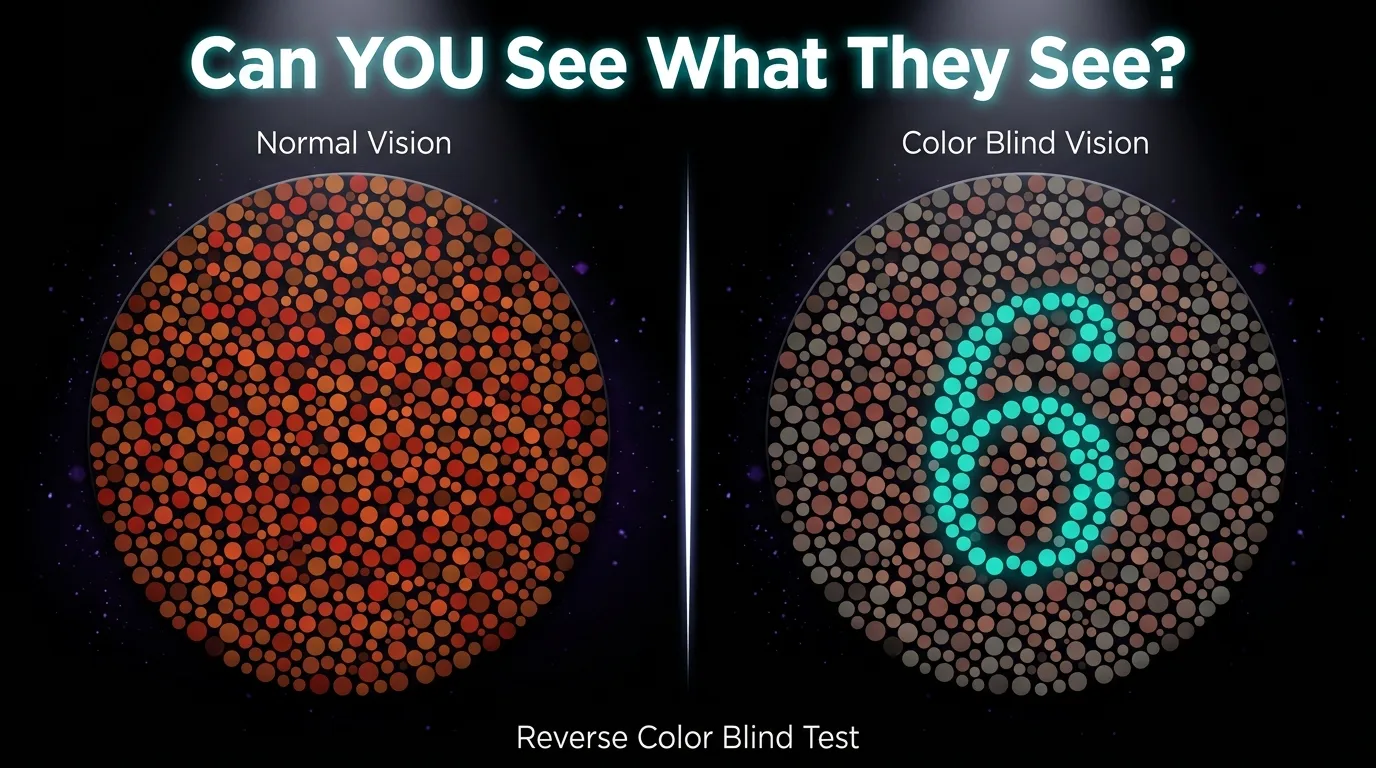
A reverse color blind test shows images where people with color blindness can see a hidden number or shape that people with normal vision cannot. It works by exploiting confusion lines in human color perception. Unlike a standard color blind test, the roles are flipped here. The test is not clinically validated but has gone viral multiple times because the experience genuinely surprises people.
What Is a Reverse Color Blind Test?
Human color vision runs on three types of cone cells: L-cones (long-wave, peaking around 560nm), M-cones (medium-wave, peaking around 530nm), and S-cones (short-wave). Together they give you three-dimensional color perception. People who are missing one cone type, called dichromats, see color in only two dimensions.
This is where confusion lines come in. A confusion line in LMS color space is a set of colors that all look identical to a specific type of dichromat. To their brain, those colors register as the same hue. Standard Ishihara plates hide a digit using colors that protanopes or deuteranopes will struggle to separate from the background.
Reverse plates do the opposite. They use colors pulled from two nearby confusion lines. Normal trichromatic vision sees the variation between those lines, which creates visual noise that masks the figure completely. A dichromat's brain collapses both lines into one tone, so the contrast between the two groups becomes visible and the hidden digit pops out clearly.
Shinobu Ishihara developed the test in 1917 for the Japanese Army, and it was adopted internationally by 1929. He included hidden digit and transformation plates in his original 1917 series. Reverse color blind plates are not a modern invention. They have been part of color vision science from day one.
Take the free color blind test on ToolsBracker to check your own color vision first.
What Do You See? Reverse Test Results by Vision Type
If you have normal color vision, you will not see a hidden number. If you have red-green color blindness, you will. Here is how it breaks down by type:
| Vision Type | What You See on a Reverse Test |
|---|---|
| Normal trichromatic | Background dot pattern only, no shape |
| Protanopia (L-cone absent) | Hidden number or shape clearly visible |
| Deuteranopia (M-cone absent) | Hidden number or shape clearly visible |
| Tritanopia (S-cone absent) | Rarely visible, most reverse tests use red-green confusion lines |
Protanopia affects about 1% of males due to the complete absence of L-cones. Deuteranopia affects another 1% of males, with M-cones absent. Together they are the most common form of color vision deficiency and the primary target of reverse test design.
Tritanopia is far rarer, affecting roughly 0.008% of the population. Most reverse test images are built around red-green confusion lines, so tritanopes often see very little difference from what a normal viewer sees.
Why These Tests Go Viral
Think about why "the dress" spread across the internet in 2015. People genuinely love discovering that their perception of the same image differs from everyone else around them. A reverse color blind test creates a real "can you see this?" challenge you can drop into any group chat.
There is also a scientific twist most people miss. Research by MJ Morgan and A. Adam published in 1992 found that dichromats can detect color-camouflaged objects that trichromats completely miss in natural settings. In certain situations, color blind vision is genuinely an advantage. Reverse tests are a direct visual demonstration of exactly this.
Craig S. Kaplan at the University of Waterloo has studied dichromatic steganography, the principle of hiding digital information in images that only dichromats can perceive. Nicolas Burrus built the DaltonLens library to simulate how different types of CVD experience color. The science behind these viral images runs a lot deeper than a fun online quiz.
For a full guide to all types of color blind tests including clinical standards, read our color blind test guide.
Do Animals Pass Reverse Color Blind Tests?
Dogs are natural dichromats with cone peaks at 430nm and 555nm, putting their color perception in a range functionally similar to red-green color blind humans. A dog looking at a reverse test plate designed around red-green confusion lines would theoretically perceive the hidden image just as clearly as a person with protanopia or deuteranopia.
Cats are also dichromatic, limited primarily to blues and greens with no meaningful red or orange perception.
The reverse test experience is not some rare quirk of human biology. It is simply what dichromatic vision looks like, and a large portion of the animal kingdom experiences color this way by default. Standard Ishihara plates would be largely meaningless to most dogs and cats. The "hidden" digit would not be hidden at all.
Are Reverse Color Blind Tests Accurate?
These tests are not clinically validated. The American Optometric Association (AOA) opposes online vision tests generally, stating they fall below the medical standard of care.
Screen calibration matters more here than with most online tests. Monitor brightness, color profiles, and ambient lighting all affect how the plate images render on your display. Clinical research describes reverse color blind plates as "unavoidably fragile" due to their dependency on precise color reproduction. A result on one screen may not match a result on another.
That does not make them worthless. A reverse test is a curiosity check and a quick personal experiment. But it cannot tell you which type of CVD you have, how severe it is, or whether you need treatment. See an optometrist for any of that.
If you are already thinking about color blind glasses, read our EnChroma color blind test review before spending anything.
Frequently Asked Questions
What is a reverse color blind test?
A reverse color blind test shows images where people with color blindness can see a hidden number or shape that people with normal vision cannot. It works by using color combinations along confusion lines that normal trichromatic vision cannot distinguish but dichromatic vision can.
What do you see on a reverse color blind test if you have normal vision?
People with normal color vision typically see only the background dot pattern with no hidden shape or number visible. The image is specifically designed so the hidden element is invisible to trichromatic eyes but clear to color deficient eyes.
Did reverse color blind tests exist before the internet?
Yes. Shinobu Ishihara included hidden digit and transformation plates in his original 1917 series. Reverse color blind plates are not a modern invention but a core part of color vision science that predates digital technology by over a century.
Are reverse color blind tests accurate?
Reverse tests are not clinically accurate. The American Optometric Association opposes online vision tests as below medical standard of care. Screen calibration and lighting conditions significantly affect results. Use them for curiosity only and see an optometrist for a formal diagnosis.
Why can color blind people see what normal vision cannot?
Color blind individuals (dichromats) perceive color in two dimensions rather than three. All colors along a single confusion line look identical to them, which removes the visual noise that overwhelms normal vision and makes the hidden figure suddenly clear.
Do dogs and cats see reverse color blind test images?
Dogs are natural dichromats with cone peaks at 430nm and 555nm, similar to red-green color blind humans. They would theoretically perceive hidden images in reverse tests designed around red-green confusion lines. Cats are also dichromatic and would likely respond similarly.
Curious how your color vision compares? Take the free Color Blind Test on ToolsBracker. No signup, instant results, find out in under 2 minutes.
Free, no signup, results in seconds.
Take the Color Blind Test