Verbal Memory Test: What's a Good Score and Why You Forget the Middle Words
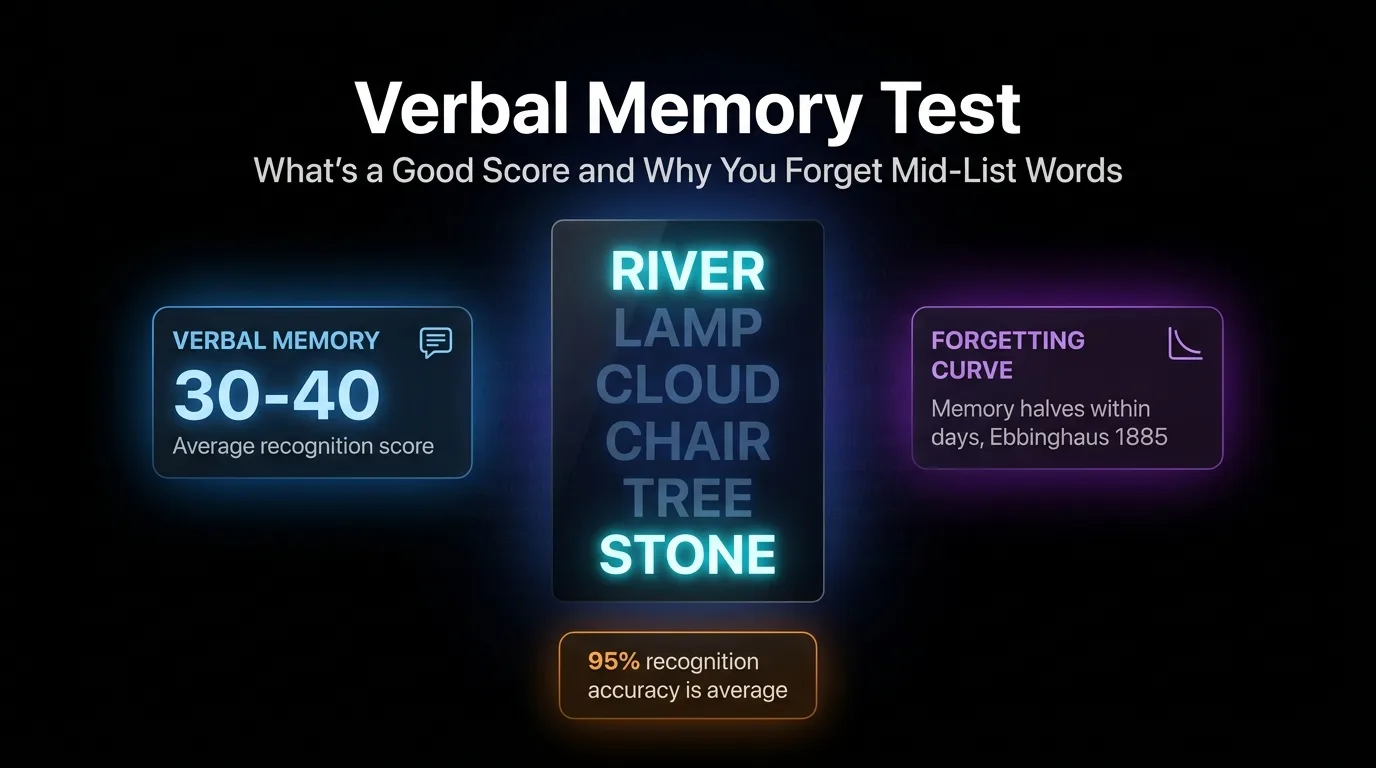
The average score on an online verbal memory test is 30 to 40 words at roughly 95% recognition accuracy. Raw score is not the most interesting part, though. You will reliably remember the first and last words on the list better than the ones in the middle, a pattern researchers have studied since 1962. Here is what your score means, why that pattern happens, and how memory researchers have understood forgetting since 1885.
What Is a Verbal Memory Test
A verbal memory test measures how well you encode, retain, and retrieve words and other language-based information. That makes it a different system from the two memory tests people often confuse it with. Digit span handles numbers, and sequence memory handles spatial order. Verbal memory is purely about language.
Online versions almost always use an old/new recognition format. A word flashes on screen and you decide whether you have seen it already, marking it "Seen," or whether it is fresh, marking it "New." Most browser tests run on a three-strike rule, ending the moment you give a third wrong answer. You can take the Verbal Memory Test to see where your own score lands before reading on.
Recognition like this is easier than free recall, because the word in front of you acts as its own cue. That is also why recognition memory holds up better with age than recall does. This measures something different from a digit span test, which tests numerical short-term memory instead of language. Unlike sequence memory, which tests spatial patterns, this test is purely about words.
Average Verbal Memory Score by Age
Start with the headline numbers. On recognition-style online tests, the global average sits at 30 to 40 words with accuracy around 95%. A score of 81 to 100 puts you in the 90th to 97th percentile. Anything above 100 lands in the top 3% of test takers.
| Age | Average Score |
|---|---|
| 18-29 | 58 words (peak encoding speed) |
| 30-44 | 54 words |
| 45-59 | 46 words |
| 60-74 | 38 words |
| 75+ | 29 words |
Verbal memory generally peaks in the mid-twenties and starts a steady slide after 50. Hartshorne and Germine's 2015 research, built on more than 48,000 online participants, found that cognitive abilities peak at different times rather than all at once. Short-term memory tops out around age 22, while crystallized intelligence such as vocabulary keeps climbing well into your forties and beyond. That split is why an older adult can lose a step on raw recall while still knowing far more words than a 22-year-old.
Why You Always Forget the Middle of the List
Murdock's 1962 research gave this pattern its name: the serial position effect. Your odds of recalling a word depend heavily on where it sat in the list, and plotting those odds produces a U-shaped curve. Words near the start get recalled well because you had time to rehearse them into long-term memory, an advantage called the primacy effect. Words near the end get recalled well because they are still sitting in short-term memory, the recency effect. The middle gets neither head start, so it falls into the dip of the U.
Glanzer and Cunitz proved the two effects come from separate systems in 1966. When they added a 30-second delay filled with a distracting task before recall, the recency effect vanished completely while the primacy effect stayed fully intact. One memory store had been emptied while the other had not, which is hard to explain if a single system were doing all the work.
There is a stranger wrinkle on top of position. Research by Lohnas and Kahana found a U-shaped link between how common a word is and how well it gets recalled, with both rare and very common words beating ordinary mid-frequency ones. In recognition tests specifically, rare words tend to be spotted more accurately than everyday words, because their novelty makes them stand out.
The Forgetting Curve: What Ebbinghaus Discovered in 1885
The German psychologist Hermann Ebbinghaus published Über das Gedächtnis in 1885 and drew the first documented forgetting curve. His core finding was blunt: memory of newly learned information roughly halves within days unless you deliberately review it. Almost every modern study method built around spaced review traces back to that one observation.
The finding has aged remarkably well. In 2015, Murre and Dros's 2015 replication reproduced Ebbinghaus's original results with modern methods, confirming that a 140-year-old curve still describes how forgetting works.
What Affects Your Verbal Memory Score
Vocabulary is the biggest lever. A larger word store correlates strongly with better verbal memory, because a richer semantic network gives your brain more hooks to tell similar words apart and hold onto them.
Reading habits feed the same effect. Some research suggests regular readers score around 15% higher on verbal recognition tests than people who rarely read, most likely through that vocabulary advantage rather than anything magical about reading itself.
Lifestyle matters too. Bilingualism and high social engagement both show protective effects against verbal memory decline and count among the modifiable factors aging researchers track. Stress pushes the other way: anxiety tends to drag down performance on the early trials specifically, and chronically high cortisol impairs the hippocampal function that memory formation depends on. Studies including work by Stricker and colleagues in 2021 have found population-level differences in verbal memory performance between sexes, though that reflects group research trends rather than predicting any one person's score.
Can You Improve Your Verbal Memory
The biggest gains come from how you study, not how hard. Active recall leads the list: testing yourself on material strengthens memory far more than reading it over again, an effect researchers call the testing effect.
Elaborative encoding helps too. Building a quick sentence or short story that links a new word to something you already know lays down a stronger, easier-to-retrieve trace than repeating the word on its own.
Spaced repetition is the technique with the deepest research behind it. Pimsleur formalized it in 1967 by spreading review across expanding intervals instead of cramming. Nakata's 2015 study of 128 students found those expanding intervals improved learning by 4.6 to 8.5% over studying at equal intervals, and Ebbinghaus had already found in his own work that spaced review was roughly 9 times faster than rote repetition for memorizing poetry.
Chunking rounds it out, grouping words into familiar units rather than treating each one as an isolated item. This is the same chunking technique that lets memory athletes push their digit span far past the usual limit.
Frequently Asked Questions
What is a good score on a verbal memory test?
The global average on online recognition-style verbal memory tests is 30 to 40 words at roughly 95% accuracy. A score of 81 to 100 puts you in the 90th to 97th percentile, and scores above 100 represent the top 3% of performers.
Why do I always forget the middle of the list?
This is the serial position effect, established by Murdock's 1962 research. Words at the beginning get rehearsed into long-term memory, known as the primacy effect, and words at the end are still active in short-term memory, the recency effect. Middle words get neither advantage, so they are recalled least reliably.
Does verbal memory decline with age?
Yes, but gradually. Performance peaks in the mid-twenties and declines steadily after age 50, falling from an average near 58 words at ages 18 to 29 to around 29 words at ages 75 and up. Recognition memory tends to hold up better against aging than recall memory does.
Can you improve your verbal memory?
Yes, mostly through technique. Active recall, meaning testing yourself, outperforms passive re-reading. Spaced repetition, formalized by Pimsleur in 1967, improved learning by 4.6 to 8.5% in controlled research, and Ebbinghaus found spaced review roughly 9 times faster than rote repetition for memorizing poetry.
Want to see where your verbal memory lands? Take the Verbal Memory Test on ToolsBracker, work through the word list, and get your score the moment you slip up three times.
Free, no signup, results in seconds.
Take the Verbal Memory Test