What Is the Fastest Typing Speed Ever Recorded?
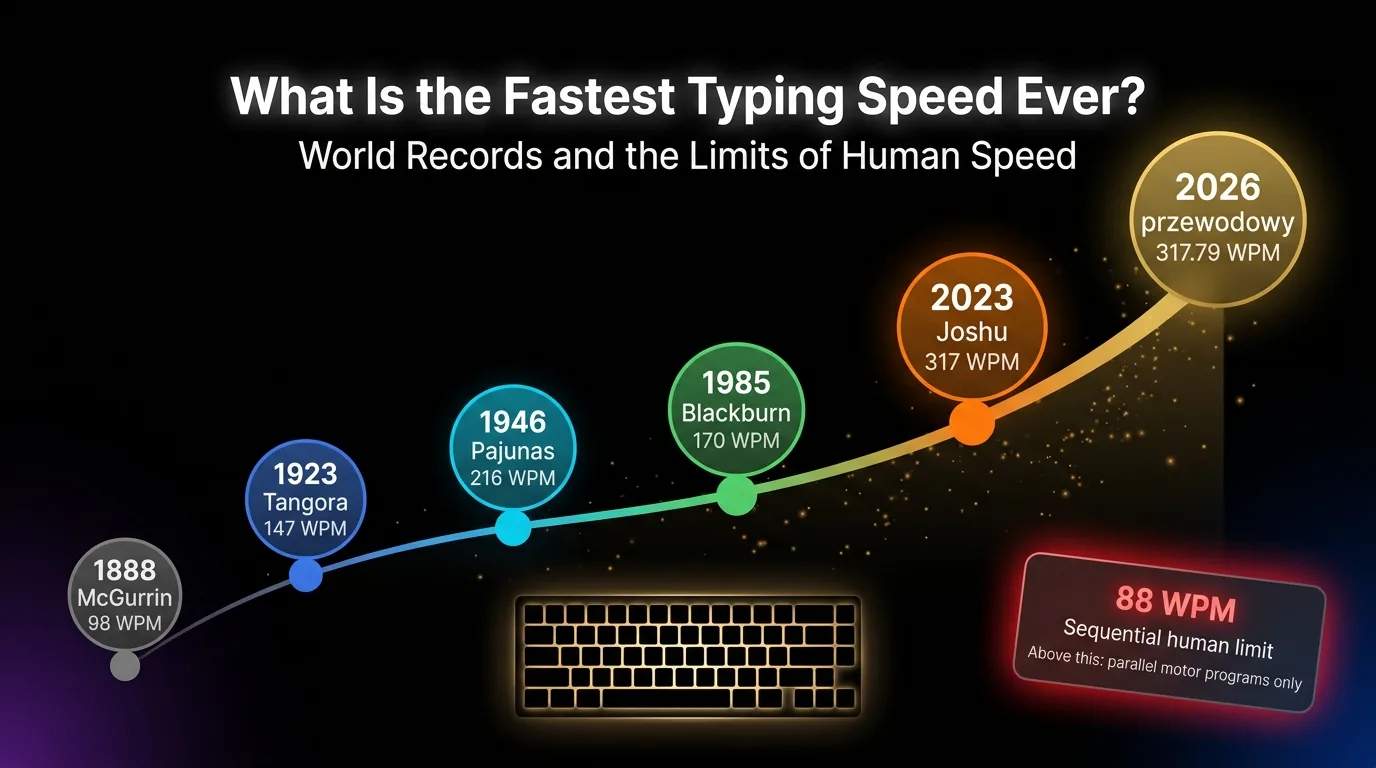
The highest verified typing speed on a standard keyboard is 317.79 WPM achieved by przewodowy on Monkeytype on January 26 2026. The TypeRacer record is held by Joshu at 317.443 WPM from July 3 2023. There is no active Guinness World Record for standard keyboard typing speed. Guinness dropped the category in 1987. Here is every verified record and the science behind these extreme speeds.
The Records That Actually Count
Most articles claiming to list the Guinness World Record for typing speed cite a category that has not existed since 1987. Guinness World Records dropped the standard keyboard WPM category because variations in hardware, typing method, and test conditions made objective comparison across attempts impossible. The active Guinness typing records today cover specific measurable tasks. Shashank Katke holds the current title for fastest time to type the alphabet with spaces: 3.25 seconds, set on February 25 2024. That is a different benchmark from raw WPM.
The verified speed records for typing live on competitive platforms with their own anti-cheat infrastructure:
| Platform | Record Holder | WPM | Date |
|---|---|---|---|
| Monkeytype (verified burst) | przewodowy | 317.79 | Jan 26 2026 |
| TypeRacer (maintrack) | Joshu | 317.443 | Jul 3 2023 |
| 10FastFingers | Platform peak | ~243 | Various |
| Unofficial burst | MythicalRocket | 305 | 2024 |
These are burst records, not sustained performance. No individual has posted a verified 60-second test above 300 WPM on a standard keyboard. przewodowy set his mark on a 15-second Monkeytype English Time test. Joshu's TypeRacer result came on a maintrack race-length text with built-in verification: TypeRacer requires any user posting above 100 WPM to pass a typing challenge before the score is logged. The TypeRacer data archive shows the full history of maintrack competition results.
Joshu won the Keymasters 2023 tournament and typed his record on an Apple Magic Keyboard with scissor switches in California. MythicalRocket used a SteelSeries Apex Pro with optical switches. Shorter key travel is a genuine mechanical factor at these speeds: less physical distance per keystroke means faster finger return and tighter parallel motor waves. Sean Wrona, the Ultimate Typing Champion, documented the history of competitive typing in Nerds per Minute: A History of Competitive Typing. Take the free Typing Speed Test to find your own benchmark.
The Historical Record Timeline
The documented line of speed records starts on July 25 1888. Frank McGurrin defeated Louis Taub in a public contest in Cincinnati, winning $500 and typing 98.11 WPM on a Remington No. 1. Later that same year he reportedly reached 125 WPM blindfolded, demonstrating that eye-free finger positioning could outpace any visual-search method on the same hardware. The contest established a competitive baseline for what was achievable on a mechanical keyboard and set the first reference point the industry could point to.
Albert Tangora pushed that ceiling to 147 WPM sustained over one full hour in 1923 on a manual Underwood typewriter. Margaret Hamma reached 149 WPM on June 20 1941 on an IBM electric, matching that endurance output on a machine with lighter key actuation. Neither number was a short burst. Sustaining those speeds across 60 continuous minutes on hardware that required real physical force per keystroke is a different kind of accomplishment from a modern sprint test.
The landmark that stood for decades came on June 19 1946. Stella Pajunas typed 216 WPM at the International Commercial Schools Contest held at Goldblatt's Department Store Auditorium in Chicago on an IBM electric typewriter using a standard QWERTY layout. That number held as the most-cited speed record for a generation and was reached under contest conditions with witnesses.
Barbara Blackburn appeared in Guinness from 1976 to 1985, credited with sustaining 150 WPM for 50 minutes across 37,500 keystrokes on a Dvorak keyboard and reaching a sprint of 170 WPM. Her records were accepted without independent testing, partly due to lobbying from a Dvorak advocate. Her 1985 appearance on Late Night with David Letterman became widely documented: she could not demonstrate her claimed speed under observation. The historical listing remains, but the absence of independent verification has never been resolved.
The shift to digital platforms and modern keyboard hardware changed what was achievable. N-key rollover removed the physical limit that prevented multiple simultaneous keystrokes from registering as separate inputs. Shorter switch travel reduced the distance each finger needed to travel between characters. For the first time, burst speeds above 300 WPM on a standard keyboard became a real outcome rather than a theoretical ceiling.
Why 300 WPM Is Humanly Possible But 400 WPM Is Not
Sequential finger tapping has a biological ceiling of roughly 88 WPM, set by synaptic transmission speed through the motor pathway. Every typist consistently above that threshold is already executing keystrokes in parallel without consciously doing so: the next key is being pressed before the previous finger fully lifts. At 100 WPM the rate is 8.33 keystrokes per second, still at the outer boundary where sequential execution can contribute. At 200 WPM it reaches 16.67 keystrokes per second, which is biochemically impossible to execute one at a time.
Timothy A. Salthouse's 1984 research published in the Journal of Experimental Psychology quantified the psychomotor limits governing interkey intervals at the high end of skilled performance. Oulasvirta and Kristensson's 136 million keystroke study confirmed that rollover typing, pressing the next key before the previous finger releases, accounts for 40 to 70 percent of keystrokes among elite typists. That parallel execution pattern is what what counts as good WPM looks like at its upper boundary.
Eye-hand span is the cognitive constraint that most typists hit before their fingers do. At 40 WPM a typist reads roughly four characters ahead of where their fingers are landing. At 70 WPM that buffer extends to six characters. At 150 WPM and above it expands to nine or more. Maintaining that visual lead while processing incoming text is what separates 300 WPM from 200 WPM more than any hardware specification.
The theoretical sustained ceiling for reading and reproducing natural prose is around 200 to 230 WPM, bounded by reading comprehension rates and word-recognition processing. Burst records above 300 WPM use short, high-frequency words that let the typist operate on pattern-fire alone, bypassing linguistic processing entirely. That is why where your speed ranks differs so sharply between a 15-second burst of common words and a sustained test on varied text.
Stenotype Records: A Different Category
Mark Kislingbury holds the Guinness record for stenotype at 370 WPM, set on March 25 2022 in Houston using a LightSpeed steno writer at 95.4% accuracy. He previously set 360 WPM in 2004. Both records are real but they are not comparable to standard keyboard typing.
A stenotype machine uses 22 unlabeled keys arranged for chording: pressing multiple keys simultaneously produces a complete syllable or word in a single stroke. The stroke-to-word ratio averages around 0.8, compared to approximately 5 individual keystrokes per word on a standard QWERTY keyboard. The input system itself operates on different mechanics entirely. Comparing stenotype WPM to keyboard WPM is like comparing rowing strokes per minute to running steps per minute as if they measure the same thing.
For context on the global typing speed average that most keyboard users actually land near, that number sits roughly 270 WPM below either of these record lines.
Frequently Asked Questions
What is the fastest typing speed ever recorded?
The highest verified burst speed on a standard keyboard is 317.79 WPM by przewodowy on Monkeytype on January 26 2026. The TypeRacer maintrack record is 317.443 WPM by Joshu from July 3 2023. No verified sustained 60-second record above 300 WPM on a standard keyboard currently exists.
Is there a Guinness World Record for typing speed?
Not for standard keyboard WPM. Guinness dropped that category in 1987 because variations in machines, keyboard layouts, and test conditions made objective comparison impossible. Current active Guinness typing records cover specific tasks like typing the alphabet. Most sites citing a Guinness WPM record are citing a category that no longer exists.
How fast did Barbara Blackburn type?
Guinness listed her as sustaining 150 WPM for 50 minutes on a Dvorak keyboard between 1976 and 1985, with a sprint of 170 WPM. Her records were accepted without independent testing and she failed to demonstrate her claimed speed on Late Night with David Letterman in 1985. Her historical listing remains, but independent verification was never completed.
Is 317 WPM humanly possible?
Yes, for short bursts on common words. Sequential finger tapping is biologically capped at roughly 88 WPM by synaptic transmission speed. Above that, typists use parallel motor programs where the next key is pressed before the previous finger releases. At 317 WPM nearly every keystroke overlaps. This is achievable in 15-second bursts using high-frequency short words but has not been sustained across a 60-second test.
What is the difference between TypeRacer and Monkeytype records?
TypeRacer uses randomized literary passages with a stop-on-error mechanic and requires users posting above 100 WPM to pass a typing verification challenge before scores are logged. Monkeytype allows customizable word sets and shorter test durations. Both platforms are legitimate but measure different conditions. Burst records on Monkeytype 15-second tests use simpler common words than TypeRacer maintrack passages, so direct WPM comparisons between platforms carry caveats.
Curious how your speed compares? Take the free Typing Speed Test on ToolsBracker. No signup, instant results, see exactly where your speed ranks among all typists.
Free, no signup, results in seconds.
Take the Typing Speed Test