Red Green Color Blind Test: Types, Symptoms, and How It Works
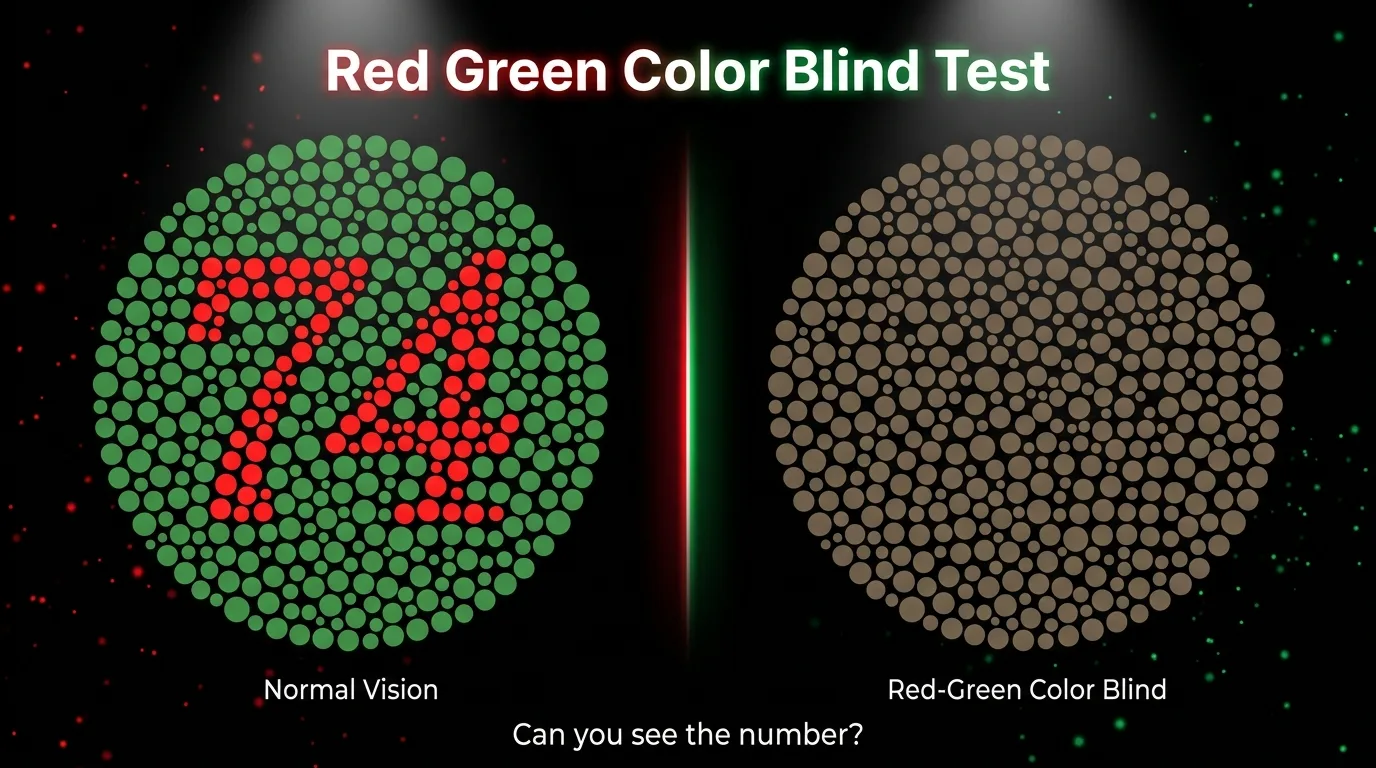
Red-green color blindness is the most common form of color vision deficiency, affecting about 8% of males and 0.5% of females worldwide. It has four subtypes: protanopia, protanomaly, deuteranopia, and deuteranomaly. The red green color blind test uses Ishihara plates to identify which colors you struggle to distinguish. One important fact most people get wrong: red-green color blind people do not see in black and white.
The 4 Types of Red-Green Color Blindness
Red-green color blindness splits into two families. Deutan types involve the M-cone (green-sensitive). Protan types involve the L-cone (red-sensitive). Within each family there is a mild form, where the cone is present but mis-tuned, and a severe form, where the cone is missing entirely.
The National Eye Institute describes red-green color blindness as the most commonly inherited color vision disorder, with both deutan and protan types carried on the X chromosome in a recessive pattern.
| Type | Cone Affected | What Happens | Severity |
|---|---|---|---|
| Deuteranomaly | M-cone (green) shifted | Green looks more red | Mild to moderate |
| Deuteranopia | M-cone (green) missing | Cannot distinguish red from green | Severe |
| Protanomaly | L-cone (red) anomalous | Red appears greener and less bright | Mild to moderate |
| Protanopia | L-cone (red) missing | Red appears very dark (scoterythrous) | Severe |
Deuteranomaly is the most common form overall and accounts for roughly half of all red-green CVD cases. Protanopia is worth understanding separately: red does not just blend with green. It appears very dark, sometimes close to black, because the L-cones that process red wavelengths are absent entirely.
For a complete overview of all color vision deficiency types including blue-yellow and monochromacy, read our color blind test guide.
What Does a Red Green Color Blind Test Check?
The standard red green color blind test uses Ishihara plates: circles filled with colored dots that hide a number inside. People with normal color vision read the number. People with red-green CVD either see a different number or see nothing at all.
The 14-plate Ishihara edition has 97% sensitivity and 100% specificity for red-green color vision deficiency. It catches almost every case. The full 38-plate set can actually miss mild presentations because the additional plates introduce more ambiguity into the scoring.
No Ishihara test can tell you whether you have a protan or deutan type. That distinction needs an anomaloscope, the clinical gold standard, where you adjust a red-green light mix until it matches an orange reference. A standard Ishihara screen tells you that red-green CVD is present. The anomaloscope tells you exactly which cone is affected.
You can take a free color blind test on ToolsBracker right now using the same Ishihara method. No signup, instant results.
What Do Red-Green Color Blind People Actually See?
Not black and white. That is the most common misconception about color blindness. Seeing the world only in shades of gray is achromatopsia, an extremely rare separate condition affecting roughly 1 in 30,000 people.
Red-green color blind people see a full range of colors. The struggle is with specific pairs that look identical or near-identical depending on the shade and lighting.
- Cyan and gray can look the same
- Rose-pink and gray are easily confused
- Blue and purple can be hard to separate
- Yellow and neon green look very similar
- Certain shades of red and green are genuinely indistinguishable
Traffic lights come up constantly as a concern. Red-green color blind drivers use position rather than color. Red is always on top, green is always on bottom. Most people with CVD adapt automatically and drive safely.
Practical hazards tend to be context-specific. Telling ripe from unripe fruit by color is genuinely difficult. Red and green electrical wiring is a real hazard in older systems. Cooked meat color as a doneness indicator is unreliable. These are the everyday friction points, not a world stripped of color.
The History Behind the Red Green Color Blind Test
John Dalton (1766-1844), the English chemist best known for atomic theory, gave the first scientific description of color blindness in 1794. He noticed something odd about a pink cranesbill flower. In daylight it looked sky blue. By candlelight it looked red. He published his observations in a paper called "Extraordinary facts relating to the vision of colours."
Dalton assumed his eyes contained a blue-tinted fluid filtering out certain wavelengths. He was wrong about the mechanism, but his description was precise enough that the condition was named Daltonism in his honor.
The story has a remarkable postscript. Dalton willed his eyes for scientific study after his death. They were preserved. In 1995, Hunt et al. at the University of London ran DNA analysis on the tissue and confirmed he had deuteranopia. He was missing the OPN1MW gene, which codes for the green cone opsin. A man who first described color blindness in 1794 was formally diagnosed 200 years later.
The molecular picture came together in 1989 when Jeremy Nathans published landmark research identifying the OPN1LW and OPN1MW genes at position Xq28 on the X chromosome. This location explains the prevalence gap. Men carry one X chromosome: one mutated allele is enough. Women carry two and need mutations on both before CVD manifests, which is why 8% of men are affected but only 0.5% of women.
Is There a Cure for Red-Green Color Blindness?
No FDA-approved cure exists for congenital red-green color blindness as of 2025.
The most promising research comes from Jay and Maureen Neitz at the University of Washington. Their team delivered functional opsin genes via gene therapy to adult squirrel monkeys that had lived with red-green CVD their whole lives. The monkeys gained color vision as adults. Human clinical trials are currently in development based on these results.
EnChroma glasses and similar tinted lens products help some people differentiate colors better in specific lighting. They filter out wavelengths where the cone sensitivities overlap. They do not restore normal color vision and are not effective for everyone.
The FAA explicitly states that color-correcting lenses including the X-Chrom lens are not acceptable for pilot medical certification. For a detailed look at how accurate EnChroma glasses tests actually are, read our EnChroma color blind test review.
Red-Green Color Blindness and Web Design
The W3C's WCAG Success Criterion 1.4.1 requires that color not be the only visual means of conveying information. This standard directly protects red-green color blind users, who make up around 8% of the male population.
The same design mistakes appear constantly in products built without this in mind.
- Red error states shown alongside green success states with no text label or icon to distinguish them
- Charts where red and green are the only differentiators between data series, with no pattern fill or shape variation
- Form validation that uses color alone to mark errors, with no message text or border change alongside it
Fixing these rarely means a full redesign. Adding a text label, an icon, or a simple pattern overlay next to the color cue is usually enough. The WCAG 1.4.1 guidelines from W3C cover exactly what is required to make color-dependent UI accessible.
Curious about what only color blind people can see? Read our reverse color blind test explainer.
Frequently Asked Questions
What is a red green color blind test?
A red green color blind test uses Ishihara plates, colored dot patterns hiding numbers, to check whether you can distinguish red from green. The 14-plate version has 97% sensitivity for detecting red-green deficiency. It is the most common initial screening tool used worldwide.
What are the 4 types of red-green color blindness?
The four types are deuteranomaly (most common, green appears shifted toward red), deuteranopia (M-cones missing, cannot distinguish red from green), protanomaly (red appears shifted and less bright), and protanopia (L-cones missing, red appears very dark). Deuteranomaly and deuteranopia are deutan types. Protanomaly and protanopia are protan types.
Do red-green color blind people see in black and white?
No. Seeing only in black and white is achromatopsia, an extremely rare condition affecting around 1 in 30,000 people. Red-green color blind people see a full range of colors but struggle to distinguish specific pairs like cyan and gray, rose-pink and gray, or blue and purple.
How common is red-green color blindness?
Red-green color blindness affects approximately 8% of males and 0.5% of females worldwide, based on Jennifer Birch's 2012 prevalence analysis. People of European descent have the highest rates at around 8-9% of men. Inuit and Aboriginal Australian populations have lower rates of approximately 1.9 to 2.5%.
Can red-green color blindness be cured?
There is no FDA-approved cure for congenital red-green color blindness as of 2025. Gene therapy research by Jay and Maureen Neitz at the University of Washington has restored color vision in adult primates and human trials are in development. Tinted lenses can help differentiate some colors but do not restore normal color vision.
Who was the first person to describe red-green color blindness?
John Dalton, the English chemist, gave the first scientific description in 1794 after noticing unusual color perceptions in his own vision. The condition was named Daltonism in his honor. In 1995, DNA analysis at the University of London confirmed Dalton had deuteranopia, specifically a missing OPN1MW gene.
Ready to check your red-green color vision? Take the free Color Blind Test on ToolsBracker. Uses the same Ishihara method, no signup, instant results.
Free, no signup, results in seconds.
Take the Color Blind Test